FINWIRES · TerminalLIVE
FINWIRES

KOSPI

KOSPI
IndexIndex

456 stories mentioning KOSPIUpdated 1d ago

Opened up 1.8% on the US-Iran deal and strong May export prices driven by a surge in semiconductor-linked products.

What's the latest news on KOSPI?

Asia

Market Chatter: South Korea Overtakes India to Become World's Sixth-Largest Stock Market

South Korea's equity market surpassed India to become the world's sixth-largest stock market, owing to a surge in semiconductor stocks, Bloomberg News reported Tuesday.The total market capitalization of South Korea-listed firms jumped 86% so far in 2026 to $5 trillion, while the Indian stock market's total capitalization has decreased to $4.8 trillion, the report said.Samsung Electronics (KRX:005930) and SK Hynix (KRX:000660), both now valued at over $1 trillion, fueled the country's stock market rally through their dominance in AI memory chips, the report said.This helped the Korea Composite Stock Price Index or Kospi, more than double so far this year and pushed South Korea ahead of Canada, Germany, the UK, and France in terms of market capitalization, Bloomberg said.Despite South Korea's larger stock market, India's economy remains considerably bigger at $4.15 trillion as compared to the former's $1.93 trillion, the report said, citing International Monetary Fund estimates.Shares of Samsung Electronics rose 1% while those of SK Hynix declined nearly 3% in recent trade.(Market Chatter news is derived from conversations with market professionals globally. This information is believed to be from reliable sources but may include rumor and speculation. Accuracy is not guaranteed.)

^BSE^KOSDAQKOSPI^NSEKRX:000660KRX:005930
South Korea's Inflation Surges to Over Two-Year High in May as Fuel Costs Surge
US Markets

South Korea's Inflation Surges to Over Two-Year High in May as Fuel Costs Surge

South Korea's annual inflation rate accelerated sharply to 3.1% in May from 2.6% in April, the highest reading since March 2024, as the Middle East conflict-driven oil shock sent petroleum prices up 24.2% from a year earlier.Analysts expected a 3% rate for the month, according to Investing.com.On a monthly basis, consumer prices were up 0.5%, unchanged from the pace of growth between March and April.The surge in fuel costs was the main driver behind the headline inflation reading. Gasoline prices jumped 23.1% year over year, while diesel prices rose 33.3%, pushing the wider petroleum products category to its largest annual increase since July 2022 during the Russia-Ukraine war.Elsewhere, the prices of food and non-alcoholic beverages jumped 1.6% year over year in May, significantly faster than the 0.3% increase in April. This marked the largest jump in food prices in three months.Meanwhile, the country's annual inflation rate excluding food and energy was 2.5%, compared with the prior reading of 2.2%. Month over month, core consumer prices inched up 0.5%, against the previous 0.3% rise.The Middle East conflict continues to drive global energy prices, prompting the Bank of Korea to maintain its steady interest rate policy during its May meeting. The BoK kept its policy rate unchanged at 2.5%, as widely expected.BoK Governor Shin Hyun-song on Monday said South Korea's strong economic expansion provides the central bank with the flexibility to prioritize inflation control.Speaking at the BoK International Conference in Seoul, Shin highlighted the country's exceptional first-quarter performance, with real GDP rising 3.6% year over year."The growth is very strong here in Korea," Shin was quoted by Korea JoongAng Daily as saying. "First-quarter growth is super strong, especially when measured in terms of gross domestic income rather than gross domestic product.""[Strong economic growth] poses fewer impediments to adjusting monetary policy in light of inflation," Shin reportedly said. "I think it gives us a lot more leeway to conduct monetary policy, and I think, in a very effective way, to address inflation on this occasion."

^KOSDAQKOSPI
International

South Korea's Annual Inflation Rate Accelerates to 3.1% in May

South Korea's annual inflation rate gained speed at 3.1% in May from 2.6% in April, according to data from the Ministry of Data and Statistics published Tuesday.Analysts expected a 3% rate for the month, according to Investing.com.On a monthly basis, consumer prices were up 0.5%, unchanged from the pace of growth between March and April.Meanwhile, the country's annual inflation rate excluding food and energy was 2.5%, compared with the prior reading of 2.2%. Month over month, core consumer prices inched up 0.5%, against the previous 0.3% rise.

^KOSDAQKOSPI
International

Asia Week Ahead: Manufacturing Activity; Policy Rate Decision; and Inflation Prints

For the week ahead in Asia, manufacturing activity will be in focus as S&P Global releases a broad mix of purchasing managers' index reports covering multiple economies.The week opens with a flurry of manufacturing PMI readings for May, followed by inflation data from South Korea and Indonesia on Tuesday.Mid-week, Australia's first-quarter GDP report will take center stage, while markets will also watch a heavy batch of readouts from Vietnam.Thursday will be lighter, led by Australia's April trade report, before Friday brings India's policy rate decision and GDP figures and inflation readouts from multiple regions.Here's what to watch in the week ahead.MONDAY, June 1The week kicked off with a flurry of S&P Global's purchasing managers' index (PMI) reports covering May manufacturing activity across the region.China's manufacturing activity eased after the seasonally adjusted RatingDog China General Manufacturing PMI came in at 51.8, compared with 52.2 in the previous month and the consensus estimate of 51.4 from Investing.com.Data from the National Bureau of Statistic similarly showed factory activity easing, with the official purchasing managers' index falling to a neutral 50 from 50.3 in April.A reading above 50 means growth, while a reading below 50 indicates contraction.Manufacturing activity similarly slowed in Australia as new orders fell sharply for a third consecutive month amid rising costs and ongoing supply-chain disruptions linked to the war in the Middle East.In contrast, Japan's manufacturing production expanded, with the latest S&P Global Japan Manufacturing PMI coming in at 54.5, compared with 55.1 in April, matching the flash data.South Korean manufacturing output also expanded during the month, hitting its highest in five years due to a rise in production and new order volumes, S&P Global said.India, Taiwan and Vietnam were also among the regions that experienced improved output during May.Meanwhile, The Philippines' manufacturing activity returned to growth in May as stronger output and a recovery in new orders offset continued weakness in exports.Moving ahead, the Melbourne Institute said its monthly inflation gauge fell in May after two consecutive monthly increases, driven largely by a decline in transport costs. The monthly cost of living also declined in May, particularly for self-funded retirees.Elsewhere, South Korea recorded a trade surplus of $26.9 billion in May, a new all-time high, and marking the third straight month of more than $20 billion in trade surplus.TUESDAY, June 2Focus shifts Tuesday to inflation data coming in from South Korea.Economists at ING said consumer prices could reach 3% year on year in May, reflecting higher input costs that are likely to be passed on to consumers.Pipeline cost pressures are also likely to reflect in Indonesia's inflation print due Tuesday, with ANZ expecting prices to tick up to 3% from 2.42% in the prior month, the Wall Street Journal reported.Trade figures due in Indonesia the same day could also show moderating exports as the effects of front-loaded demand fade and commodity prices soften, the WSJ said, citing an RHB economist.On the activity front, S&P Global releases its monthly manufacturing PMIs for Indonesia, Malaysia, and Thailand. The Singapore Institute of Purchasing and Materials Management's PMI report is also expected.Lastly, Hong Kong will release its retail sales stats for April.WEDNESDAY, June 3Australia's first-quarter gross domestic product (GDP) data will dominate headlines Wednesday.Both Westpac and CommBank said they expect growth to have moderated during the first three months of the year, though their estimates differed.CommBank forecast a 0.2% quarterly rise in GDP, while Westpac projected 0.5%; both would be slower than the 0.8% growth recorded in the final quarter of 2025.Neighboring New Zealand will disclose first-quarter export and import price stats.Markets will also be following a speech by Bank of Japan Governor Kazuo Ueda for clues on the central bank's next interest-rate hike.Wednesday also features a heavy slate of macro data from Vietnam, including inflation, balance of trade, industrial production, and retail sales.Trading Economics expects Vietnam's May inflation to accelerate to 6% from 5.46% in April. Meanwhile, the data platform estimated the country's trade deficit could widen to $3.4 billion from $3.28 billion a month prior.Meanwhile, S&P Global will release the next batch of its PMI reports covering composite and services activity in China, India, Japan, Australia, and Hong Kong.THURSDAY, June 4Thursday will be relatively light on readouts, with Australia's April trade figures among the handful of releases of note.Australia is expected to post a trade surplus of A$2.6 billion in April, rebounding from a A$1.8 billion deficit in March - its first shortfall since late 2017, Westpac said in a preview.According to the bank, major commodity exports appeared to have increased notably during the period after recording three consecutive monthly declines.In Singapore, S&P Global's monthly PMI will be due, while Thailand will release a business confidence report.FRIDAY, June 5The tail end of the week brings a policy rate decision in India, which will also release its quarterly GDP growth figures.The Reserve Bank of India is expected to hold rates at 5.25% but could signal hawkish sentiment during its vote, the WSJ reported, citing a UOB economist.Meanwhile, a Trading Economics consensus placed the country's GDP growth rate at 7.3%, down marginally from the 7.8% recorded in the final quarter of 2025.ANZ Research said the economy stayed broadly healthy in the fiscal fourth quarter, although growth eased slightly in March as manufacturing, exports and profit margins came under pressure due to global disruptions, the WSJ reported.Taiwan is set to report monthly inflation data, with ING expecting consumer prices to rise above the 2% target for the first time since April 2025. The bank expects inflation to accelerate to 2.2% year on year in May from 1.7% in April, reflecting Taiwan's reliance on imported energy, which leaves the economy vulnerable to higher global prices."We expect inflation to peak toward the middle of this year, raising the risks for a potential central bank rate hike at the coming meetings," ING said in a preview.Thailand and the Philippines will similarly report their respective inflation rates for May, with the latter also releasing industrial production stats.Lastly, Singapore will report its retail sales figures for April.

ASX 200^BSE^HNX^HOSEHang Seng^JKSEFTSE Bursa Malaysia KLCIKOSPINikkei 225^NSE^NZ50^PSEI^SETShanghai Composite^STI^SZSETaiwan Weighted
Asia

South Korean Shares Rise to Record High on Chip, AI-related Stock Gains; Hanmi Science Shares Jump Over 4%

South Korean stocks climbed to a new high on Monday, buoyed by strong gains in semiconductor firms and AI-related shares. Shares of major market movers Samsung Electronics (KRX:005930), SK Hynix (KRX:000660), and LG Electronics (KRX:066570) added over 10%, more than 1%, and nearly 30%, respectively, at market close.The Korea Composite Stock Price Index or Kospi rose 312.23 points, or 3.7%, to end at 8,788.38. The Kosdaq decreased by 24.77 points, or 2.3%, to close at 1,050.03.In economic news, South Korea recorded a trade surplus of $26.9 billion in May, a new all-time high, and marking the third straight month of more than $20 billion in trade surplus, the Ministry of Trade, Industry and Energy said in a Monday release.It came as exports increased 53.2% to $87.8 billion from the year-ago period, the sharpest pace of growth since 1984. Imports rose 20.8% to $60.8 billion.Semiconductor exports surged 169.4% to a record $37.16 billion, while non-semiconductor exports increased by 16%. Rising memory chip prices amid increased capital spending by major U.S. technology companies pushed chip exports higher.In corporate news, Hanmi Science (KRX:008930) signed a technology licensing agreement for Sonefpeglutide (HM15912), a short bowel syndrome drug, with Eli Lilly and Co., according to a Monday filing with the Korea Exchange.The technology licensing agreement is worth up to $1.26 billion, including a $75 million upfront payment and up to $1.185 billion in development, regulatory, and commercial milestones, along with royalties based on future sales.Shares of the company rose more than 4% at market close.

^KOSDAQKOSPIKRX:000660KRX:005930KRX:008930KRX:066570
South Korea's Trade Surplus Hits Record High as May Exports Surge 53% on Semiconductor Boom
US Markets

South Korea's Trade Surplus Hits Record High as May Exports Surge 53% on Semiconductor Boom

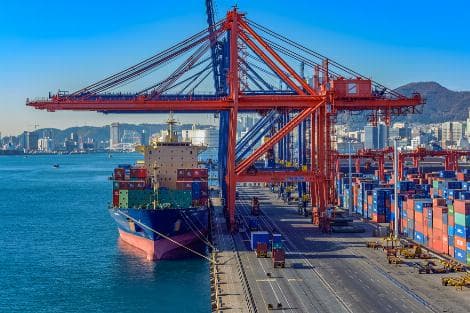
South Korea's trade surplus hit an all-time high in May, driven by a semiconductor boom that pushed exports to their fastest growth rate in four decades, according to data released Monday by the Ministry of Trade, Industry and Energy.Trade surplus reached nearly $27 billion during the month, according to figures from the ministry.Exports increased 53.2% to $87.8 billion, topping the $80 billion mark for the third straight month, the ministry said. This marks the steepest percentage increase since January 1984, beating the 48.4% growth forecast, according to Investing.com."It is truly an unprecedented pace, raising market expectations again and again and ​exceeding them again and again," Reuters quoted Meritz Securities economist Stephen Lee as saying.Semiconductor exports surged 169% to $37.2 billion during the year, led by capital investments by U.S. technology companies.Dynamic Random-Access Memory chip exports soared 370% to $18.6 billion while NAND memory chip exports jumped 207% to $1.7 billion during the month.Computer exports soared 291% to $4.18 billion due to demand for solid-state drives for artificial intelligence servers.Wireless communication device exports increased 13% to $1.46 billion."Market sentiment appears to be shifting toward the view that the semiconductor upcycle will last longer than previously expected," Bloomberg quoted BNP Paribas economist Jeeho Yoon as saying.Petroleum product exports jumped 47% to $5.25 billion on rising oil prices, but volume slid 24% amid export control measures.Automobile exports were an outlier, sliding 5.9% to $5.83 billion, led by logistics disruptions due to the war in the Middle East, as well as difficulties with car parts purchases due to domestic fires and fewer working days."The pickup in South Korea's exports in May underscores the resilience of external demand despite uncertainty from the Iran war," Bloomberg Economics' Hyosung Kwon said.An increase in semiconductor profits could also lead to rises in housing, equities, and wages, Bloomberg reported, citing Kwon.By destination, exports to China topped the list, increasing 81% to $18.9 billion, while exports to the U.S. rose 59% to nearly $16 billion. Sales to Southeast Asia jumped 58% to $15.9 billion and to the EU, up by 2% at $6.2 billion."Exports are likely to remain strong at least through the end of this year and into early next year," Bloomberg said, citing Yoon.Strong artificial intelligence-driven demand for semiconductors recently translated into surging equity valuations for South Korea's tech giants. Nvidia supplier SK Hynix (KRX:000660) last week joined the $1 trillion market capitalization club for the first time.SK Hynix's rally came just weeks after its rival, Samsung Electronics (KRX:005930) also topped $1 trillion in market capitalization.

^KOSDAQKOSPIKRX:000660KRX:005930
Asia

Market Chatter: Seoul, Tokyo Discuss Military Logistics Deal; to Conduct Joint Humanitarian Search, Rescue Exercise in June

South Korea and Japan discussed the possibility of a military logistics support agreement during talks on the sidelines of the Shangri-La Dialogue in Singapore, Reuters reported Sunday.Defence Minister Ahn Gyu-back held the talks with his Japanese counterpart Shinjiro Koizumi. Both parties discussed carrying out a joint humanitarian search and rescue exercise this month, which would be the ⁠first ​time in about nine years, the report said.The agreement would allow South Korea and Japan to share military logistics and supplies, including fuel, food, and ammunition, during operations and emergencies, it said.Ahn said Seoul remains cautious about pursuing the agreement, stressing that public understanding and support in both countries would be needed before moving forward, according to the report.(Market Chatter news is derived from conversations with market professionals globally. This information is believed to be from reliable sources but may include rumor and speculation. Accuracy is not guaranteed.)

^KOSDAQKOSPI
South Korea's Manufacturing Activity Rises to Five-Year High in May
US Markets

South Korea's Manufacturing Activity Rises to Five-Year High in May

South Korea's manufacturing sector logged its strongest activity in May since March 2021.The seasonally adjusted S&P Global South Korea Manufacturing Purchasing Managers' Index (PMI) rose to 54.8 from 53.6 in April, marking the strongest reading in five years, according to S&P Global's release on Monday.The data indicated a robust improvement in the sector's health, driven by higher demand and a surge in new orders that grew at the fastest pace since June 2021."Both new orders and production growth hit the highest for around five years, but anecdotal evidence from respondents often linked expansions to stock building efforts as the war in the Middle East continued to cause price increases and disrupt supply conditions for the manufacturing economy," said S&P Global Market Intelligence economist Usamah Bhatti.The surge in new orders drove production output higher, prompting manufacturers to expand their workforces. As a result, employment rose at the sharpest rate in over 13 years.Official data is expected to reflect this employment growth for May. In April, the unemployment rate ticked up to 2.8% from 2.7% the previous month, with the number of jobless individuals rising to 816,000 from 799,000. However, the total number of employed people also increased, reaching 28.96 million from 28.77 million.S&P Global noted that input costs remained under pressure, as the conflict in the Middle East drove up raw material prices, particularly oil.Bank of Korea data showed that producer prices increased for the eighth consecutive month in April, jumping 6.9% compared to a 4.1% rise in the previous month. South Korea remains vulnerable to global supply chain disruptions caused by the Middle East conflict.However, Min Joo Kang, ING's senior economist for South Korea and Japan, said overall activity in South Korea may start recovering in May."Both consumer and business sentiment are improving. We believe that the government's cash payouts should provide some buffer against a decline in consumption. For business sentiment, semiconductor performance remains strong," Kang said in a Friday note.Meanwhile, Jefferies predicted that the central bank may begin hiking rates in July due to an improving economic outlook and persistent inflation concerns."The headline numbers [in April] were weak, reflecting the Middle East conflict and some payback from the previous month's strong gains. The weakness was led by non-semiconductors such as autos, refining and durable goods consumption, while semiconductors continued to expand," Jefferies said in a note.The BoK held its key interest rate steady at 2.50% last week.

^KOSDAQKOSPI
International

South Korea Logs Record Trade Surplus in May as Export Growth Hits Four-Decade High

South Korea recorded a trade surplus of $26.9 billion in May, a new all-time high, and marking the third straight month of more than $20 billion in trade surplus, the Ministry of Trade, Industry and Energy said in a Monday release.It came as exports increased 53.2% to $87.8 billion from the year-ago period, the sharpest pace of growth since 1984. Imports rose 20.8% to $60.8 billion.Semiconductor exports surged 169.4% to a record $37.16 billion, while non-semiconductor exports increased by 16%. Rising memory chip prices amid increased capital spending by major U.S. technology companies pushed chip exports higher, the release said.

^KOSDAQKOSPI
Asia

South Korean Shares Open at New High on Technology Stock Gains

South Korean stocks opened at a new high on Monday, led by surging technology shares despite uncertainty around the negotiations between the US and Iran.The benchmark Korea Composite Stock Price Index, or Kospi, rose 0.1%, or 9.52 points, to open at 8,485.67. The Kosdaq decreased 0.2%, or 2.03 points, to open at 1,072.77.Major market movers Samsung Electronics (KRX:005930) and LG Electronics (KRX:066570) gained nearly 7% and over 25% in early morning trade, respectively.Oil prices jumped over 2% on Monday after Israel ordered troops to push deeper into Lebanon, fueling concerns over a broader conflict in the region and potential disturbances to global energy supplies. Brent crude rose 2.1% to $93.05 a barrel, while U.S. West Texas Intermediate (WTI) crude gained 2.5% to $89.53 in early trading.

^KOSDAQKOSPIKRX:005930KRX:066570
International

South Korea's Manufacturing Activity Hits Five-Year High, S&P Global Data Shows

South Korean manufacturing output expanded in May, S&P Global said on Monday.The latest seasonally adjusted S&P Global South Korea Manufacturing PMI rose to 54.8 from 53.6 in April.S&P Global said the reading was the highest in five years, driven by the rise in production and new order volumes.The demand for manufactured products was fueled by the need to build and maintain inventories due to the disruption caused by the war in the Middle East, according to S&P.

KOSPI
South Korea's Industrial Output, Retail Sales Weaken in April as Iran War Disrupts Supply Chains
US Markets

South Korea's Industrial Output, Retail Sales Weaken in April as Iran War Disrupts Supply Chains

South Korea's industrial output and retail sales weakened in April amid global supply disruptions and elevated fuel costs stemming from the US-Iran conflict.Industrial production slipped 0.6% from the previous month, according to data released Friday by the Ministry of Data and Statistics.Mining and manufacturing output slid 0.7%, while construction fell 1.4%. The service sector also declined 1%, with finance and insurance dropping 7.7%. The information and telecommunications segment bucked the trend, rising 4.3%.Within manufacturing, semiconductor output rose 3.1%. Automobile production, however, fell 10%, and petroleum output plunged 19.4%, the steepest drop in decades, reflecting supply disruptions tied to the US-Iran conflict.The finance ministry, in a separate statement, attributed part of the decline to production disruptions caused by a fire at an auto parts supplier.On a year-over-year basis, industrial output rose 2.4%, softer than the 3.7% increase in March.Despite the weak April figures, the ministry expects industrial activity to rebound in May, citing a recovery in consumer sentiment and a business sentiment index that reached its highest level in 43 months."It appears the figures were affected both by a base effect following gains in February and March and by the Middle East war," Lee Doo-won, a senior official at the data ministry, was quoted by The Korea Herald as saying.Meanwhile, retail sales contracted 3.6% from the prior month but rose 1.6% year on year. Sales of semi-durable goods were flat, while durable goods, including telecommunications equipment and computers, slumped 11.1%. Non-durable goods such as fuel edged down 1.1%.The government said it will continue fuel price relief measures and other steps to minimize the economic fallout from the conflict.The outlook for this year's economy was also revised upward, with the Bank of Korea raising its growth forecast to 2.6% from 2% and the Korea Development Institute lifting its projection to 2.5% from 1.9%.The BoK held its benchmark interest rate at 2.5% amid ongoing uncertainties surrounding the war, but signaled a more hawkish stance later in the year.

^KOSDAQKOSPI
International

South Korea Retail Sales Growth Eases to 1.6% in April

South Korea's retail sales increased 1.6% on an annual basis in April, slowing from 5.0% growth in the prior month, data from Statistics Korea showed on Friday.On a month-on-month basis, retail sales contracted 3.6%, reversing the 1.9% increase in March and marking the steepest drop since July 2020, according to the government data.

^KOSDAQKOSPI
International

South Korea's Industrial Production Growth Slows to 2.4% in April

South Korea's industrial production grew 1.5% year over year in April, easing from a 3.9% increase in the previous month as output across most sectors moderated, according to data released by Statistics Korea on Friday.While activity in the construction sector remained in negative territory, albeit at a slower pace, yearly output growth in manufacturing and services slowed to 1.6% and 3.5% from 4.2% and 5.4%, respectively, while public administration growth accelerated to 2.9% from 2.4%, the data showed.On a seasonally adjusted basis, industrial production declined 0.7% in April, reversing the 0.6% monthly growth in March, Statistics Korea said.

^KOSDAQKOSPI
Asia

Market Chatter: US, Iran Reach Tentative 60-Day Ceasefire Extension

The U.S. and Iran have tentatively agreed to extend a ceasefire for two months while initiating new negotiations over Tehran's nuclear program, fueling optimism that the ongoing three-month conflict may soon end, Bloomberg News reported on Thursday, citing a source familiar with the discussions.The anonymous source confirmed a prior Axios report, though President Donald Trump has not yet signed off on the terms, the newswire said.While both sides have previously celebrated progress and Trump has often claimed a deal was imminent, the impasse has repeatedly persisted, the publication said.Vice President JD Vance told reporters that the two nations are exchanging proposals on specific language regarding Iran's nuclear capabilities, and noted that Iran appears to be engaging in good faith, with tangible progress underway, the report said.(Market Chatter news is derived from conversations with market professionals globally. This information is believed to be from reliable sources but may include rumor and speculation. Accuracy is not guaranteed.)

^BSE^HNX^HOSE^Hang Seng^JKSEFTSE Bursa Malaysia KLCI^KOSDAQKOSPINikkei 225^NSE^PSEI^SETShanghai Composite^STI^SZSETaiwan Weighted
Asia

South Korean Shares Decline on Fresh Conflict in Middle East, Higher Oil Prices

South Korean shares closed lower on Thursday, snapping a four-day winning streak as investors were skeptical of the recent rally led by AI boom.Investors also took a moment to ponder the increasing oil prices after the U.S. attacked Iran despite the ongoing peace talks.The Korea Composite Stock Price Index or Kospi fell 43.41 points, or 0.5%, to end at 8,185.29. The Kosdaq also decreased by 28.77 points, or 2.5%, to close at 1,104.36.Oil prices climbed on Thursday after fresh U.S. strikes in Iran raised concerns over shipping disruptions in the Strait of Hormuz. Brent crude added more than 3% to around $97 a barrel, while U.S. crude gained over 3%, as Iran's Revolutionary Guards said they had targeted a U.S. airbase following American strikes on a site seen as threatening regional shipping and U.S. forces.In economic news, the Bank of Korea kept its base rate unchanged at 2.50% for the inter-meeting period amid high inflationary pressure and uncertainties surrounding developments in the Middle East, the central bank said in a Thursday release.In corporate news, Megabox JoongAng took out a loan of 21 billion won from its parent and entertainment giant ContentreeJoongAng (KRX:036420) to secure liquidity, according to a filing with the Korea Exchange on Thursday.Shares of ContentreeJoongAng fell nearly 1% at market close.

^KOSDAQKOSPIKRX:036420
Bank of Korea Holds Interest Rates Steady, Raises Growth and Inflation Forecasts
US Markets

Bank of Korea Holds Interest Rates Steady, Raises Growth and Inflation Forecasts

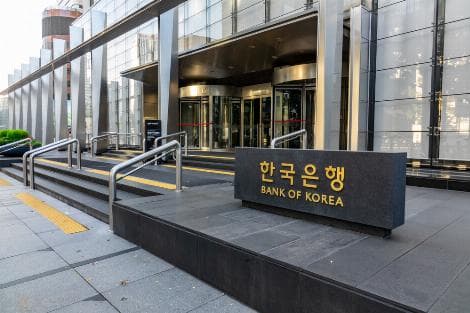
The Bank of Korea left its benchmark interest rate unchanged at 2.50% on Thursday, citing heightened uncertainty surrounding the conflict in the Middle East and its potential impact on inflation and economic growth.The decision was widely expected, with 30 of 32 economists polled by Reuters forecasting the central bank would keep rates unchanged."Given the uncertainties surrounding developments in the Middle East and that their spillover effects remain high, the board judged that it would be appropriate to maintain the current level of the base rate," the central bank said in a statement.The BOK said inflationary pressures had increased due to the war, while domestic growth had strengthened more than previously expected, driven by robust exports and semiconductor-related investment.Five board members supported keeping rates unchanged, while two members voted for a 25-basis-point increase to 2.75%, signaling growing concern over inflation risks.The bank's updated dot plot also pointed to a more hawkish policy outlook, with most board members projecting rates to rise toward 3% over the next six months, while two members saw rates reaching 3.25%.The central bank said rising global oil prices and supply constraints linked to the Middle East conflict were expected to push inflation higher in the coming months.The BOK raised its economic growth forecast for this year to 2.6% from 2% projected in February, supported by strong semiconductor exports, resilient consumption, and supplementary fiscal spending.Consumer price inflation is now projected at 2.7% this year, up from the previous forecast of 2.2%, while core inflation is expected at 2.4%, compared with the earlier estimate of 2.1%."Inflation appears to have more room to rise, so the likelihood of the Bank of Korea taking action in July looks fairly high," Cho Yong-gu, a fixed-income strategist at Shinyoung Securities, was quoted as saying by Bloomberg News.The meeting marked the first policy decision chaired by Governor Shin Hyun Song, who was scheduled to hold his first press conference later Thursday."The BOK's economic outlook itself seems relatively reasonable and free of major surprises, so the focus now will likely shift to the dot plot, any dissent favoring a hike, and the governor's qualitative comments on guidance," Cho was quoted by Bloomberg News as saying.The BOK's hawkish projections reinforced expectations for further tightening later this year."We expect the BOK will hike its policy rate to 2.75% at the next meeting in July, followed by another rate hike in October, pushing the rate toward 3.00% by the end of the year," Stephen Lee, an economist at Meritz Securities in Seoul, said, according to Reuters.

KOSPI
International

Bank of Korea Keeps Base Rate Unchanged at 2.50%

Bank of Korea kept its base rate unchanged at 2.50% for the inter-meeting period amid high inflationary pressure and uncertainties surrounding developments in the Middle East, the central bank said in a Thursday release.Five members of the Monetary Policy Board backed keeping the base rate steady, while Chang Yongsung and Ryoo Sangdai opposed, calling for a 0.25% rate hike to 2.75%.The decision was in line with a poll conducted by Reuters, wherein 30 of ​32 economists anticipated the rate freeze decision. A survey conducted by Bloomberg also witnessed 22 out of 23 economists agreeing on a steady rate decision.Inflation pressures have risen due to the Middle East conflict, while stronger exports raised growth beyond earlier expectations, and financial stability risks remain.Consumer inflation rose to 2.6% in April on the jump in petroleum prices, while core inflation remained unchanged at 2.2%, and inflation expectations remained in the upper 2% range.The central bank expects inflationary pressure to build further amid higher oil prices and growing demand, raising inflation forecasts for this year to 2.7% for headline inflation and 2.4% for core inflation, both above its February projections.

^KOSDAQKOSPI
Asia

South Korean Shares Open Lower After US Attack on Iran, Oil Gains

South Korean stocks opened lower on Thursday, as investors adopted a wait-and-watch approach amid a slowdown in the rally led by AI boom. Investors also took a moment to ponder over the increasing oil prices after the U.S. attacked Iran despite the ongoing peace talks.The benchmark Korea Composite Stock Price Index, or Kospi, fell 0.8%, or 62.97 points, to open at 8,165.73. The Kosdaq increased 0.2% to open at 1,135.84.Oil prices rose in early Asian trading after new U.S. strikes near Bandar Abbas and drone interceptions near the Strait of Hormuz raised supply concerns, with U.S. crude futures and Brent crude both gaining more than 2%.According to a U.S. official, the overnight strikes targeted an Iranian ground control station seen as a threat to U.S. forces and commercial shipping near the Strait of Hormuz, while four Iranian attack drones were also shot down.The strikes came hours after U.S. President Donald Trump rejected Iranian media reports that Tehran and Oman could jointly oversee shipping in the strategic waterway under a potential peace agreement.

^KOSDAQKOSPI
International

Bank of Korea Holds Rate Steady as Expected

^KOSDAQKOSPI

Showing 301-320 of 456

Track with the FINWIRES app suite