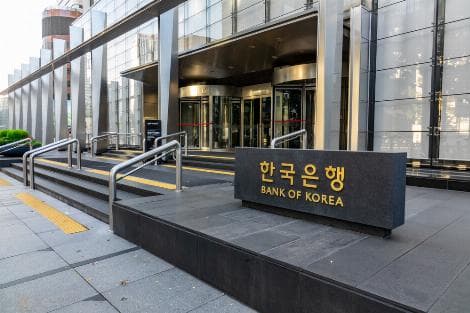
The Bank of Korea left its benchmark interest rate unchanged at 2.50% on Thursday, citing heightened uncertainty surrounding the conflict in the Middle East and its potential impact on inflation and economic growth.
The decision was widely expected, with 30 of 32 economists polled by Reuters forecasting the central bank would keep rates unchanged.
"Given the uncertainties surrounding developments in the Middle East and that their spillover effects remain high, the board judged that it would be appropriate to maintain the current level of the base rate," the central bank said in a statement.
The BOK said inflationary pressures had increased due to the war, while domestic growth had strengthened more than previously expected, driven by robust exports and semiconductor-related investment.
Five board members supported keeping rates unchanged, while two members voted for a 25-basis-point increase to 2.75%, signaling growing concern over inflation risks.
The bank's updated dot plot also pointed to a more hawkish policy outlook, with most board members projecting rates to rise toward 3% over the next six months, while two members saw rates reaching 3.25%.
The central bank said rising global oil prices and supply constraints linked to the Middle East conflict were expected to push inflation higher in the coming months.
The BOK raised its economic growth forecast for this year to 2.6% from 2% projected in February, supported by strong semiconductor exports, resilient consumption, and supplementary fiscal spending.
Consumer price inflation is now projected at 2.7% this year, up from the previous forecast of 2.2%, while core inflation is expected at 2.4%, compared with the earlier estimate of 2.1%.
"Inflation appears to have more room to rise, so the likelihood of the Bank of Korea taking action in July looks fairly high," Cho Yong-gu, a fixed-income strategist at Shinyoung Securities, was quoted as saying by Bloomberg News.
The meeting marked the first policy decision chaired by Governor Shin Hyun Song, who was scheduled to hold his first press conference later Thursday.
"The BOK's economic outlook itself seems relatively reasonable and free of major surprises, so the focus now will likely shift to the dot plot, any dissent favoring a hike, and the governor's qualitative comments on guidance," Cho was quoted by Bloomberg News as saying.
The BOK's hawkish projections reinforced expectations for further tightening later this year.
"We expect the BOK will hike its policy rate to 2.75% at the next meeting in July, followed by another rate hike in October, pushing the rate toward 3.00% by the end of the year," Stephen Lee, an economist at Meritz Securities in Seoul, said, according to Reuters.