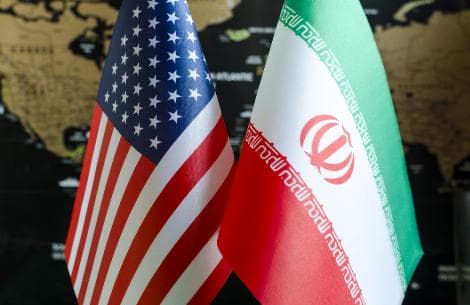
The US and Iran signed a memorandum of understanding to end their war and reopen the Strait of Hormuz, in a deal that includes at least $300 billion in potential financing for Tehran.
The landmark agreement arrives after more than three months of hostilities resulted in the effective closure of the Strait of Hormuz, which connects the Persian Gulf with the Gulf of Oman and the Arabian Sea.
The document, signed by US President Donald Trump and his Iranian counterpart, Masoud Pezeshkian, ensures toll-free passage of commercial vessels between the Persian Gulf and the Sea of Oman for 60 days.
Text of the MOU was widely available, with Pezeshkian sharing a copy on X. Both parties have at least 60 days to hammer out a final deal.
In collaboration with regional partners, the US will develop a plan for at least $300 billion geared toward Iran's economic development.
The $300 billion benefit will come via a private fund aimed at spurring investments into Iran, Reuters previously reported, citing a source with direct knowledge of the deal.
As part of the preliminary deal, Iran agreed that it will not procure or develop nuclear weapons. In addition, the MOU declares an "immediate and permanent" end of all military operations, including in Lebanon.
West Texas Intermediate crude oil was down 1.8% at $75.39 a barrel intraday Thursday, while Brent fell 1.6% to $78.28. Both benchmarks were on track for back-to-back weekly declines.
In the US, gasoline prices averaged $3.999 per gallon on Thursday, compared with $4.025 the day before and $4.129 a week ago, according to data from AAA, a travel organization that tracks fuel prices in the country. Prices at the pump reached $4.5150 a month ago.
"Oil prices extend declines as the US and Iran sign a peace agreement, with Middle East supply expected to recover sooner than previously anticipated," ING Bank said in a report. "Sentiment is further weighed by the (International Energy Agency's) weaker 2026 demand outlook.
On Wednesday, the IEA lowered its global oil demand forecast for this year amid war-driven headwinds while projecting a rebound next year.
"Attention has now shifted to the pace at which traffic through the Strait of Hormuz can recover," Saxo Bank said in a report. "An estimated 100 million barrels of crude and refined products are already loaded on tankers and waiting to leave the Gulf, while regional producers are taking steps to restart shut-in production."