The U.S. added dozens of Chinese companies to a list of firms it says support Beijing's military, a move that could heighten tensions between the world's two largest economies.
The Pentagon added several major Chinese technology, electric-vehicle, and battery companies, including Alibaba (HKG:9988), Tencent (HKG:0700), BYD (HKG:1211, SHE:002594), CATL (HKG:3750, SHE:300750), Baidu (HKG:9888), and Nio (HKG:9866), to its list of "Chinese military companies," according to a notice published Monday.
The U.S. Department of Defense said the companies were designated under Section 1260H of the National Defense Authorization Act, which requires the Pentagon to identify entities it deems linked to China's military or that support military-civil fusion efforts.
The Pentagon briefly published the updated list in February, when President Donald Trump's planned visit to China was still under consideration, before withdrawing it without explanation.
It later asked the Federal Register to remove the notice from public inspection and withdraw it from publication, stating: "We would like to remove this notice from public inspection and withdraw the notice from publication," without providing a reason.
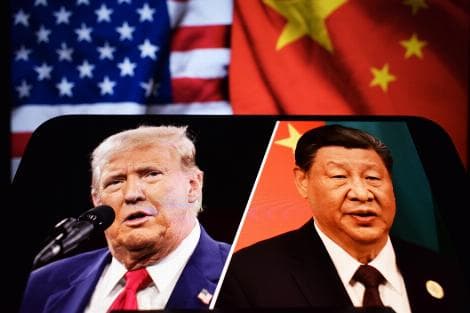
The list was released less than a month after Trump met Chinese President Xi Jinping in Beijing, where the two leaders discussed trade and technology issues.
The updated list also includes Huawei Technologies, DJI, Semiconductor Manufacturing International (HKG:0981, SHA:688981), China Mobile (HKG:0941, SHA:600941), China Telecom (HKG:0728), China Unicom (HKG:0762), Hikvision (SHE:002415), SenseTime (HKG:0020), Unitree Robotics, TP-Link, among others.
Also included was WuXi AppTec (HKG:2359, SHA:603259), one of China's largest pharmaceutical research and manufacturing services providers.
WuXi AppTec said separately in a statement on Tuesday that its inclusion on the list was "clearly a mistake" and that it would take immediate steps to challenge the designation.
The company said it does not meet the statutory criteria for a "Chinese military company" and is not owned, controlled by, or affiliated with any Chinese military or government entity.
China's embassy in Washington criticized the designation, saying Beijing opposed "making discriminatory lists to go after Chinese companies."
"The U.S. should stop its wrong practice and create a fair, just, and non-discriminatory environment for Chinese companies," an embassy spokesperson said in a statement to Reuters.
The spokesperson added that Chinese companies operate in accordance with local laws and regulations.
The new list is largely unchanged from the withdrawn February version, except for the addition of memory chipmakers CXMT and YMTC, whose earlier removal had sparked criticism from U.S. lawmakers.
Bloomberg News reported earlier that the Pentagon's decision to initially remove YMTC and CXMT prompted the list's swift withdrawal in February.
The notice also removed several entities from the previous list, including CNOOC China and CNOOC International Trading, both of which are owned by state-controlled oil producer CNOOC.
However, the Pentagon added CNOOC subsidiary China BlueChemical (HKG:3983) to the updated list and said in the filing that CNOOC is directly owned and controlled by China.
The notice also removed several entities from the previous list, including Anhui Sun Create Electronics, China International Information Services, China National Chemical Engineering, China Traffic Construction USA, COSCO Shipping Finance, among others.
Companies designated under the program may seek reconsideration by submitting information to challenge their inclusion on the list, according to the notice.
While the designation carries limited immediate legal consequences, the Pentagon has increasingly used the list to restrict companies' access to U.S. military contracts and research funding.
The designation is also viewed by investors as a warning signal that can precede broader U.S. trade, investment, or regulatory restrictions.