Research
UBS Upgrades China Unicom (Hong Kong) to Buy from Neutral; Price Target is HK$7.10
China Unicom (Hong Kong) (HKG:0762) has an average rating of overweight and mean price target of HK$7.28, according to analysts polled by FactSet.
HKG:0762
13 stories mentioning HKG:0762Updated 3d ago
Every FINWIRES story that references HKG:0762, newest first.
Recent broker actions mentioned in FINWIRES coverage. Compiled from wire headlines; not investment advice.
China Unicom (Hong Kong) (HKG:0762) has an average rating of overweight and mean price target of HK$7.28, according to analysts polled by FactSet.
China Unicom (Hong Kong) (HKG:0762) has an average rating of overweight and mean price target of HK$7.25, according to analysts polled by FactSet.
China Unicom (Hong Kong) (HKG:0762) recorded 248.5 million 5G network subscribers in the second quarter.The telco's overall subscriber count, encompassing mobile and broadband users, reached 1.31 billion in the three months, according to a Tuesday filing with the Hong Kong bourse.
China Unicom (Hong Kong) (HKG:0762) reported 9.47 billion yuan in profit attributable to equity shareholders for the first half, compared with 14.5 billion yuan a year ago, a Tuesday filing showed.EPS moved to 0.31 from 0.47 year over year.For the six months ended June 30, revenue was 201.4 billion yuan, versus 200.2 billion yuan previously, the Hong Kong-listed telco added.The board did not declare an interim dividend. It paid 0.2841 yuan per share in the year-ago period.
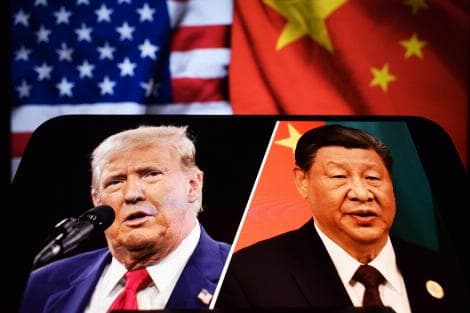
China's Ministry of Commerce on Saturday threatened to retaliate after the US Defense Department added a number of Chinese companies, including Alibaba (HKG:9988), Baidu (HKG:9888) and BYD (HKG:1211, SHE:002594), to its list of firms it deems linked with the Chinese military."China will resolutely and forcefully retaliate, and the US will bear full responsibility for the consequences," a spokesperson for the Ministry of Commerce said over the weekend, adding that "China expresses its strong dissatisfaction and firm opposition" to the designations.The Pentagon published its updated Section 1260H list on June 8, which supersedes an earlier version from January 2025. The updated roster now also includes electric-vehicle maker Nio (HKG:9866), pharmaceutical research and manufacturing services provider WuXi AppTec (HKG:2359, SHA:603259), AI robotics company Robosense Technology (HKG:2498), and Unitree Robotics, which is currently pursuing an initial public offering in Shanghai. Nvidia recently said it plans to collaborate with Unitree to build robots.The list also names telcos China Mobile (HKG:0941, SHA:600941), China Telecom (HKG:0728, SHA:601728), and China Unicom (HKG:0762), as well as chipmaker Semiconductor Manufacturing International (HKG:0981, SHA:688981), Huawei Technologies, Contemporary Amperex Technology (SHE:300750, HKG:3750) and Tencent (HKG:0700), most of which were added in January.The June update also reinstated ChangXin Memory Technologies and Yangtze Memory Technologies on the list after they were withdrawn from the February version. Both companies are among China's leading memory chipmakers and are currently pursuing public listings.As the Pentagon noted, being on the list means an entity is identified as a contributor to China's "Military-Civil Fusion strategy," supporting the modernization goals of the People's Liberation Army "by ensuring it can acquire advanced technologies and expertise developed by PRC companies, universities, and research programs that appear to be civilian entities."While these Chinese companies face no formal sanctions under the list, the Pentagon is prohibited from entering into, renewing or extending contracts with them or acquiring their products starting June 30, 2026.Several newly listed companies pushed back, with Alibaba saying it is "not a Chinese military company nor part of any military-civil fusion strategy." The company warned that it will take "all available legal action against attempts to misrepresent the company."Baidu said there was "no justification" for its inclusion, adding that it does not expect the designation to impact its business.BYD, which recently toppled Tesla as the world's top electric vehicle seller, echoed Alibaba and Baidu's statements, adding that the move will not impact its business.Meanwhile, analysts from Jefferies said the update was largely anticipated, noting that an earlier version of the list had briefly appeared in February before being withdrawn without explanation.Jefferies also noted on June 9 that while the Defense Department is prohibited from procurement of goods and services from entities in the list, "it does not restrict US citizens from engaging in trading activity with the listed companies."In a separate Jefferies note on June 9, analysts from the bank said 10 companies were removed from the list, including, most notably, CNOOC (HKG:0883, SHA:600938)."The immediate implication for companies on the 1260H list is that they are prohibited from providing any goods or services to the US military directly or via contractors. We believe the final decision-maker is the US president," said Jefferies."President Trump has just concluded his China trip, and, in our view, the US-China relationship is moving in an incrementally positive direction. In our view, President Trump is largely occupied with Iran, the high oil price (thus higher inflation risk), and the upcoming mid-term election, implying there will be less motivation for the US to escalate geopolitical tension with China."
The U.S. added dozens of Chinese companies to a list of firms it says support Beijing's military, a move that could heighten tensions between the world's two largest economies.The Pentagon added several major Chinese technology, electric-vehicle, and battery companies, including Alibaba (HKG:9988), Tencent (HKG:0700), BYD (HKG:1211, SHE:002594), CATL (HKG:3750, SHE:300750), Baidu (HKG:9888), and Nio (HKG:9866), to its list of "Chinese military companies," according to a notice published Monday.The U.S. Department of Defense said the companies were designated under Section 1260H of the National Defense Authorization Act, which requires the Pentagon to identify entities it deems linked to China's military or that support military-civil fusion efforts.The Pentagon briefly published the updated list in February, when President Donald Trump's planned visit to China was still under consideration, before withdrawing it without explanation.It later asked the Federal Register to remove the notice from public inspection and withdraw it from publication, stating: "We would like to remove this notice from public inspection and withdraw the notice from publication," without providing a reason.The list was released less than a month after Trump met Chinese President Xi Jinping in Beijing, where the two leaders discussed trade and technology issues.The updated list also includes Huawei Technologies, DJI, Semiconductor Manufacturing International (HKG:0981, SHA:688981), China Mobile (HKG:0941, SHA:600941), China Telecom (HKG:0728), China Unicom (HKG:0762), Hikvision (SHE:002415), SenseTime (HKG:0020), Unitree Robotics, TP-Link, among others.Also included was WuXi AppTec (HKG:2359, SHA:603259), one of China's largest pharmaceutical research and manufacturing services providers.WuXi AppTec said separately in a statement on Tuesday that its inclusion on the list was "clearly a mistake" and that it would take immediate steps to challenge the designation.The company said it does not meet the statutory criteria for a "Chinese military company" and is not owned, controlled by, or affiliated with any Chinese military or government entity.China's embassy in Washington criticized the designation, saying Beijing opposed "making discriminatory lists to go after Chinese companies.""The U.S. should stop its wrong practice and create a fair, just, and non-discriminatory environment for Chinese companies," an embassy spokesperson said in a statement to Reuters.The spokesperson added that Chinese companies operate in accordance with local laws and regulations.The new list is largely unchanged from the withdrawn February version, except for the addition of memory chipmakers CXMT and YMTC, whose earlier removal had sparked criticism from U.S. lawmakers.Bloomberg News reported earlier that the Pentagon's decision to initially remove YMTC and CXMT prompted the list's swift withdrawal in February.The notice also removed several entities from the previous list, including CNOOC China and CNOOC International Trading, both of which are owned by state-controlled oil producer CNOOC.However, the Pentagon added CNOOC subsidiary China BlueChemical (HKG:3983) to the updated list and said in the filing that CNOOC is directly owned and controlled by China.The notice also removed several entities from the previous list, including Anhui Sun Create Electronics, China International Information Services, China National Chemical Engineering, China Traffic Construction USA, COSCO Shipping Finance, among others.Companies designated under the program may seek reconsideration by submitting information to challenge their inclusion on the list, according to the notice.While the designation carries limited immediate legal consequences, the Pentagon has increasingly used the list to restrict companies' access to U.S. military contracts and research funding.The designation is also viewed by investors as a warning signal that can precede broader U.S. trade, investment, or regulatory restrictions.
The Pentagon added several major Chinese companies, including Alibaba (HKG:9988), Tencent (HKG:0700), BYD (HKG:1211, SHE:002594), CATL (SHE:300750, HKG:3750), Baidu (HKG:9888), and Nio (HKG:9866), to its list of "Chinese military companies," according to a notice published on MondayThe U.S. Department of Defense said the companies were designated under Section 1260H, which requires the agency to identify entities it deems linked to China's military or supporting military-civil fusion efforts.The updated list also includes Huawei Technologies, DJI, Semiconductor Manufacturing International (HKG:0981, SHA:688981), China Mobile (HKG:0941, SHA:600941), China Telecom (HKG:0728), and China Unicom (HKG:0762), among others.Also included on the list was WuXi AppTec (HKG:2359, SHA:603259), one of China's largest pharmaceutical research and manufacturing services providers.The companies were included in a previous version of the list that was briefly posted in February before being withdrawn minutes later without explanation, Bloomberg News reported separately.WuXi AppTec said separately in a statement that its inclusion on the list was "clearly a mistake" and that it would take immediate steps to challenge the designation.The company said it does not meet the statutory criteria for a "Chinese military company" and is not owned, controlled by, or affiliated with any Chinese military or government entity.While the designation carries limited immediate legal consequences, the Pentagon has increasingly used the list to restrict companies' access to U.S. military contracts and research funding, Bloomberg said.A 1260H designation is also reportedly viewed as a warning to U.S. investors and can precede tougher trade or regulatory restrictions.
ITC Properties (HKG:0199) signed a memorandum of understanding with China Unicom (Hong Kong) (HKG:0762) to explore cooperation in artificial intelligence computing infrastructure and related businesses in Hong Kong, according to a Friday bourse filing.The companies plan to collaborate on data center resources, AI computing services, and market development opportunities in Hong Kong.China Unicom Hong Kong intends to provide at least 2 megawatts of data center capacity within three months and a further 4 megawatts within six to nine months, subject to definitive agreements.The cooperation framework also covers potential participation in China Unicom Hong Kong's new data center project in Fanling, where ITC intends to secure about 8 to 10 megawatts of capacity for sublease to customers.
The U.S. Federal Communications Commission voted unanimously to advance a proposal banning all Chinese labs from testing U.S.-bound electronic devices such as smartphones and computers, Reuters reported Thursday.Currently, about 75% of U.S. electronics are tested in China, according to the report. The plan would fast-track approval for devices tested in U.S. labs or allied nations.In a separate vote, the FCC moved to bar China Mobile (SHA:600941, HKG:80941), China Telecom (SHA:601728, HKG:0728) and China Unicom (HKG:0762) from operating U.S. data centers, Reuters wrote.The agency is also considering blocking interconnection with companies linked to national security risks, including Huawei and ZTE (SHE:000063, HKG:0763), according to the report.(Market Chatter news is derived from conversations with market professionals globally. This information is believed to be from reliable sources but may include rumor and speculation. Accuracy is not guaranteed.)
China Unicom (Hong Kong) (HKG:0762) recorded a drop in its first-quarter profit and operating revenue, despite accelerating its 5G technology, according to an earnings report published Tuesday on the Hong Kong Stock Exchange.The company's shares fell less than 2% during Wednesday's afternoon trade.The telecom company's net profit attributable to shareholders fell 18% to 4.89 billion yuan from 5.93 billion yuan a year earlier.Operating revenue slipped 0.5% to 102.8 billion yuan from 103.4 billion yuan in the prior year.However, revenue from the computing power business grew 8.3% year on year to 15.4 billion yuan, including revenue from data centers, which climbed 12 from a year earlier.The company said the 5G market is growing, with a total number of nearly 242 million 5G users in the first quarter. The total number of users of Internet-of-Things terminal connections amounted to 755.1 million in the same quarter.The growth in artificial intelligence and 5G technology indicates the increasing demand for these technologies.The number of 5G base stations in China reached nearly 5 million, while the number of passive optical networks amounted to 32 million as of the end of March, government officials said at a press conference with the State Council Information Office (SCIO) on Tuesday.The 5G-Advanced technology has been rolled out in 330 Chinese cities, and terminal users of mobile Internet of Things reached 2.95 billion, the SCIO said.Unicom said the group developed more than 53,000 5G commercial projects and established more than 9,800 5G factories. Its international business revenue climbed by almost 15% year on year.Despite the global popularity of the technology, the company is at risk of being barred from operating in the U.S. due to national security concerns. The U.S. Federal Communications Commission is set to vote on the possible ban on the big three Chinese telecoms, namely, Unicom, China Mobile (HKG:0941), and China Telecom (HKG:0728, SHA:601728), on April 30.Unicom was first added to the U.S. Federal Communications Commission's list of communications equipment and services that are believed to be a threat to national security in 2022.
China Unicom (Hong Kong) (HKG:0762) recorded 242 million 5G network subscribers in the first quarter of 2026, according to a Tuesday filing with the Hong Kong bourse.The telco's overall subscriber count, encompassing mobile and broadband users, reached 1.29 billion in the three months.
China Unicom (Hong Kong) (HKG:0762) recorded an attributable profit of 4.89 billion yuan in the first quarter of 2026, down 18% from 5.93 billion yuan a year prior, according to a Tuesday Hong Kong bourse filing.Operating revenue for the three months slipped 0.5% to 102.8 billion yuan from 103.4 billion yuan in the year-ago period.
The U.S. Federal Communications Commission said it could bar three big Chinese telecommunications firms from operating data centers in the U.S. and ban U.S. interconnections with the three companies.The commission said it has tentatively concluded there are national security concerns regarding U.S. telecommunication companies connecting with companies identified in the U.S. government's "covered list."The FCC will have to seek comment regarding interconnections with the companies, among them China Mobile (HKG:0941), China Telecom (HKG:0728, SHA:601728), and China Unicom (HKG:0762), Reuters reported separately.The FCC could disallow U.S. telecommunications companies from connecting with companies that use equipment from the list, among them ZTE (HKG:0763, SHE:000063), the newswire said.The commission will vote on the possible ban on April 30.