FINWIRES · TerminalLIVE
FINWIRES

CATL Invests in New Zealand Biographite Maker CarbonScape

By
CATL Invests in New Zealand Biographite Maker CarbonScape

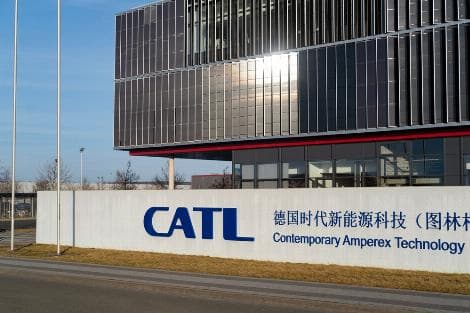
Contemporary Amperex Technology (SHE:300750, HKG:3750) or CATL has made a strategic investment in New Zealand-based bio-based graphite materials maker CarbonScape.

Through the investment, the Chinese battery maker plans "to advance the commercial scale-up and deployment" of bio-based graphite materials for next-generation battery supply chains, CarbonScape and CATL said in a joint press release on Monday.

The multi-year collaboration covers technology de-risking and scale-up, as well as strategic investment and financing.

While the companies did not disclose the financial terms of the transaction, Bloomberg reported that CATL invested to acquire a 20% stake in CarbonScape.

As part of the deal, CATL will also secure representation on CarbonScape's board, according to the press release.

The partnership seeks to establish local graphite supply chains for automakers in the U.S. and Europe.

CATL supplies batteries to major automakers, including Tesla, BMW, Mercedes-Benz, Volkswagen, Honda Motor (TYO:7267), Hyundai Motor (KRX:005380), NIO (HKG:9866, SGX:NIO) and Li Auto (HKG:2015).

The companies noted that over 75% of graphite used in batteries comes from an oil-based feedstock. CarbonScape said its technology enables the production of battery-grade graphite from forestry by-products.

"What we have built at CarbonScape is the only proven pathway to produce battery-grade graphite from forestry residues, at target cost parity with conventional graphite and with a carbon-negative footprint. CATL's investment is the most powerful validation this technology could receive," said Vincent Ledoux-Pedailles, Chief Commercial Officer of CarbonScape.

Hong Kong-based investment firm Lochpine Capital, which serves as the strategic offshore investment arm of CATL, has also made a strategic investment in CarbonScape.

"CarbonScape has developed a differentiated approach to graphite production using forestry by-products, and we are pleased to support the company alongside CATL as it advances its technology and commercialisation plans," said Blake Niu, Lead Partner at Lochpine Capital.
Related Articles

Eurozone's Private Sector Output Stabilizes in June Amid Cooling Inflation
US Markets

Eurozone's Private Sector Output Stabilizes in June Amid Cooling Inflation

Private sector output in the euro area saw a stabilization in June as inflationary pressures eased and growth in manufacturing offset a slower decrease in the services sector, after two months of decline.The seasonally adjusted S&P Global Eurozone Composite PMI Output Index rose to 50 in June from the previous month's 48.5 and the flash estimate of 49.5, final data from S&P Global showed Friday. The latest reading marks a three-month high and the first time the index has moved out of the contraction zone since March.On the services side, the PMI reached its highest level in three months at 49.4, against the prior 47.7 and the initial reading of 48.9, indicating an overall "marginal" rate of decline in business activity among service providers.Italy, Spain and Ireland logged an increase in overall business activity in June, while the downturn in Germany and France, the bloc's two largest economies, eased from the prior month. The rest of the euro area, meanwhile, achieved stability despite seeing a reduction in demand and new business volumes."A key drag on economic growth since the outbreak of the war in the Middle East has been the subduing of demand from consumers due to the energy price spike, but these inflationary pressures have shown signs of cooling markedly in June. Input cost inflation in the service sector fell in June to the greatest extent since data were first available in 1998, barring only that seen in the COVID-19 lockdowns of early 2020," S&P Global Market Intelligence Chief Business Economist Chris Williamson said. "This has helped support a revival of growth of services activity in some of the sectors which had been hardest hit by the war, notably leisure and tourism."Business confidence further improved across the bloc in June, reaching a four-month high, with companies' growth outlook over the next 12 months at its most optimistic since the outbreak of the war.

^SXXP
India Business Activity Slows in June as Manufacturing, Service Cool, S&P Says
US Markets

India Business Activity Slows in June as Manufacturing, Service Cool, S&P Says

Business activity across India's private sector slowed in June due to a decline in the manufacturing and service sectors, according to final data compiled by S&P Global and released Friday.The final HSBC India Composite Purchasing Managers' Index slid to 57.1 in June from 59.3 in May, well above the 50.0 mark that separates expansion from contraction.Manufacturers and service companies lowered their output forecasts in June, while private-sector firms also restricted the increase in selling prices as cost pressures softened, S&P said in its note Friday.Aggregate sales volumes grew at their weakest pace within three months.Job creation was also at its weakest so far this year, according to S&P.India's services PMI, released the same day, declined to 57.4 from 59.8 in May, the slowest growth in 17 months, HSBC Chief India Economist Pranjul Bhandari said in the note.The figures show a loss of momentum amid challenging market conditions and slower interest for some services.While new export orders grew at the fastest pace in three months, slowing cost pressures also curbed charge inflation as tensions in the Middle East began to cool down, Bhandari said.Norder intakes also saw the slowest expansion in more than two and a half years, S&P said.Service companies that also saw growth noted "competitive" pricing, higher e-commerce demand, and enhanced tourism. Those that saw slower growth cited challenging market conditions and subdued client interest.Service companies paused hiring as staffing counts were sufficient for current needs.Outstanding business volumes saw stability in June, according to S&P.Exports also increased during the month on demand from clients in Australia, Belgium, Canada, Germany, Malaysia, Nepal, Oman, Qatar, Singapore, the UAE, and the U.S.India's manufacturing sector would also have to step up to offset the decline in services, CNBC reported June 26, citing Morgan Stanley Chief Asia Economist Chetan Ahya.The manufacturing PMI fell to 54.2 from 55 the previous month.

^BSENifty 50
PMI: Geopolitical Disruptions, Cautious Spending Slow UAE Non-oil Private Sector Growth in June
US Markets

PMI: Geopolitical Disruptions, Cautious Spending Slow UAE Non-oil Private Sector Growth in June

Regional geopolitical strain and cautious client spending slowed the United Arab Emirates' non-oil private economic momentum, with the sector growing at its slowest pace since February 2021.The S&P Global UAE PMI fell to 50.8 in June 2026 from 52.6 a month ago, data from S&P Global showed Friday. The reading was marginally above the neutral 50 threshold, indicating a "marginal" improvement in operating conditions among non-oil industry businesses.Despite reaching a three-month peak, new business growth remained below the historical average as inflation, tourism slump and delayed client spending dampened overall demand. As a result, staff numbers fell at the fastest rate since August 2020, which also reflects rising costs and productivity drives.Backlogs in June rose at the second-slowest pace in two and a half years amid subdued capacity pressures. Meanwhile, purchasing activity recovered sharply for the month, driven by sales-driven restocking and defensive inventory building to protect against potential supply disruptions and shortages.Zooming in on Dubai, the PMI also slipped to 50.7 in June 2026 from 52 previously, marking the softest improvement in the Emirate's non-oil private sector since January 2021 amid slowing demand growth. While ongoing spending delays and Middle East conflict-related travel reductions weighed on sales growth, businesses ramped up output at the fastest pace since March 2026."Looking ahead, recent moves towards an easing of geopolitical tensions in the region should help firms recover demand and [normalize] supply chains - indeed, the greater movement of shipping along the Strait of Hormuz in June led to shorter delivery times. That said, client caution has persisted so far, and businesses have sufficiently moved to cut staff capacity, suggesting that a rebound in the non-oil sector may turn out to be gradual," S&P Global Market Intelligence principal economist David Owen said.

^DFMGI^FADGI