FINWIRES · TerminalLIVE
FINWIRES

Nikkei 225

Nikkei 225
IndexIndex

729 stories mentioning Nikkei 225Updated 1h ago

Japanese stocks opened little changed as investors stayed cautious ahead of the Bank of Japan's interest rate decision.

International

Japan's Machine Tool Orders Jump 45% in April

Japan's machine tool orders recorded a substantial year-over-year increase of 45.1%, reaching nearly 188.97 billion yen in April, according to the Japan Machine Tool Builders' Association.This growth exceeded the 28.1% rise seen in the previous month, driven by advances in both external and internal demand.Export orders rose by 45.7%, while domestic orders climbed 43.4%.On a month-over-month basis, however, orders slipped 2.3% in April.Looking at the first four months of the year, total machine tool orders grew 30.9% compared to the same period in 2025, reaching 674.76 billion yen, with overseas demand up 37.9% and domestic orders rising 13.5%.

Nikkei 225
International

Tech Sell-Off Batters Asian Stock Markets

Asian stock markets retreated Friday as traders weighed geopolitical concerns, inflation, labor issues, and booked profits in regional equity indices that recently struck record highsHong Kong, Shanghai, and Tokyo finished in the red, while Seoul's KOSPI index declined 6%, including an 8.6% tumble in bellwether Samsung Electronics shares after reports of a possible work stoppage at the semiconductor giant.The Samsung Electronics labor union plans an 18-day strike, involving 50,000 employees, from May 21 to June 7, reported The Chosun Daily news organization.In Japan, the Nikkei 225 opened evenly on Wall Street cues but declined in trading, finishing off 2% after Tokyo reported that producer prices had jumped higher in April.The benchmark Nikkei 225 eased 1,244.76 to 61,409.29, as losing issues outnumbered gainers 120 to 99.Leading the upside was industrial engineering and metal melting enterprise Dowa, up 16.1%, while printing outfit Toppan declined 16.6%.In economic news, Japan's producer price index rose 4.9% year-on-year in April, rising from the 2.9% gain logged in March and triggering concerns that the Bank of Japan will soon raise interest rates.In Hong Kong, the Hang Seng Index opened lower and declined steadily, closing down 1.6% after the recent Beijing-Washington summit concluded without any major trade agreements announced. Tech issues led the decline.The broad gauge Hang Seng fell 426.31 to 25,962.73, as losing issues outnumbered losers 76 to 13. The Hang Seng TECH Index lost 2.7% on the day, while the Mainland Properties Index fell 1.2%.Leading the upside was Wuxi Biologics, gaining 3.2%, while JD Health International declined 6.6%.On the mainland, the Shanghai Composite fell 1% to 4,135.39.On the other regional exchanges, the Taiwan TWSE declined 1.4%; the Australian ASX 200 declined 0.1%; the Singapore Straits Times Index fell 0.1%, and the Thai Set declined 1.4%. In late trading in Mumbai, the Sensex was down 0.2%The MSCI All Country Asia Pacific Index fell 2.1% on the day.

Hang SengNikkei 225Shanghai Composite
Asia

Japan Shares Tumble After BOJ Warns of Broader Summer Price Increases

Japanese shares ended sharply lower on Friday following the Bank of Japan warned that rising energy costs linked to the Middle East conflict could trigger another broad-based round of price increases around summer, raising concerns that persistent inflation may weigh on consumer spending and corporate margins.The Nikkei 225 fell 1.99%, or 1,244.76 points, to close at 61,409.29.Japanese service-sector firms are accelerating price increases as rising raw material, labour and energy costs squeeze margins, with some companies planning further hikes around summer, the Bank of Japan said in a regional survey report, according to Reuters.The BOJ said food makers, restaurants and hot spring operators were among firms moving more quickly to pass on higher costs linked partly to the Middle East conflict.Japan's producer price index rose 4.9% on year in April, the fastest pace in three years, and gained 2.3% from March, driven by higher chemical prices, up 9.2%, as well as beverages and food prices, up 4.1%.The central bank also said companies are raising prices faster than during the 2022 cost surge following the Ukraine war, as firms have become more accustomed to passing on higher expenses.On the corporate front, Dainichiseika Color & Chemicals Mfg (TYO:4116) rose 1% after saying it will carry out a group-wide restructuring to improve profitability and growth potential, including reviewing non-core businesses, streamlining operations and reorganising production sites, while targeting ROE of 9% and ROA of 5% over the longer term.Key Coffee (TYO:2594) fell 1% after outlining plans to raise ROE to 3% in fiscal 2027 and 5% by fiscal 2030, even as fiscal 2025 net income attributable to owners of parent climbed to 988 million yen from 214 million yen and net sales rose to 93.07 billion yen from 77.78 billion yen.Remixpoint (TYO:3825) slipped 1% after saying it will transfer its electricity retail business to a wholly owned subsidiary through an absorption-type company split effective Oct. 1, aiming to strengthen risk management and speed up decision-making amid volatile energy markets.

Nikkei 225TYO:2594TYO:3825TYO:4116
Asia

Japan Earnings Wrap: Hamamatsu and Square Enix Soar, Nexon Slides

Japanese stocks reporting earnings traded mixed on Friday, with gains led by semiconductor equipment makers and game developers, while some publishers and entertainment firms came under pressure.Hamamatsu Photonics K.K. (TYO:6965) rose 23% after reporting first-half results. Profit attributable to owners of parent fell 7.2% to 9.22 billion yen, while net sales increased 5.4% to 112.50 billion yen. Earnings per share came to 31.30 yen, down from 32.95 yen.The company forecast profit attributable to owners of parent of 16.4 billion yen, up 15.5%, and net sales of 232 billion yen, up 9.4%, for the fiscal year ending September 2026. Basic earnings per share are expected at 56.33 yen.Square Enix (TYO:9684) rose over 5% after reporting full-year results. Profit attributable to owners of parent rose 21.3% to 29.62 billion yen, while net sales fell 8.3% to 297.66 billion yen. Earnings per share came to 82.08 yen, up from 67.79 yen.The company forecast profit attributable to owners of parent of 31 billion yen, up 4.7%, and net sales of 298 billion yen, up 0.1%, for the fiscal year ending March 2027. It expects basic earnings per share of 85.99 yen.Nexon (TYO:3659) dropped 12% after reporting first-quarter results. Profit attributable to owners of parent rose 118% to 57.23 billion yen, while revenue increased 33.6% to 152.23 billion yen. Earnings per share came to 72.02 yen, up from 32.07 yen.For the six months ending June 2026, Nexon forecasts profit attributable to owners of parent of 73.31 billion to 80.40 billion yen, revenue of 259.19 billion to 271.91 billion yen, and earnings per share of 92.64 yen to 101.60 yen.

Nikkei 225TYO:3659TYO:6965TYO:9684
Japan Producer Prices Surge as Iran Conflict Drives Up Fuel Costs
US Markets

Japan Producer Prices Surge as Iran Conflict Drives Up Fuel Costs

Japan's wholesale prices rose at their fastest annual pace in nearly three years in April as the Iran conflict drove up fuel and chemical costs, government data showed Friday, reinforcing expectations the Bank of Japan could raise interest rates as soon as June.The corporate goods price index, which tracks the prices companies charge each other for goods and services, rose 4.9% from a year earlier. The figure marked a sharp acceleration from 2.9% in March and came in above market expectations.On a monthly basis, producer prices increased 2.3%, reflecting broad gains across energy categories including petroleum, electricity and chemicals.The latest reading adds to signs that external shocks are feeding through Japan's import-dependent economy. The yen-based import price index jumped 17.5% from a year earlier, its fastest rise since late 2022, as higher crude oil prices and a weaker currency lifted costs for firms.Energy-related items were a key driver of the monthly rise. Petroleum and coal products contributed 0.75 percentage points, while electric power, gas and water added 0.47 percentage points. Chemical-related goods also added 0.48 percentage points, reflecting higher prices for inputs such as ethylene, propylene and xylene.Export and import prices also pointed to broad cost pressures. The export price index rose 3.3% from a month earlier, led by other primary products and manufactured goods, which contributed 1.48 percentage points, and chemicals and related products, which added 1.11 percentage points.The import price index increased 4.9% on the month, with petroleum, coal and natural gas contributing 4.19 percentage points, making it the dominant driver of the rise. Electric and electronic products added 0.32 percentage points, while chemicals and related products contributed 0.15 percentage points.The inflation data has sharpened attention on the Bank of Japan's policy path after board member Kazuyuki Masu said recently that rates should be raised as early as possible if there are no clear signs of economic slowdown. His comments added to growing market bets that the central bank could move again as soon as June.Three BOJ board members had already dissented at the previous policy meeting, pushing for a rate increase, underscoring the split within the central bank over the pace of normalization.The broader concern for policymakers is whether higher energy costs remain confined to a narrow set of goods or begin to spread across a wider range of products, potentially embedding more persistent inflation in the economy.

Nikkei 225
International

Japan's Producer Price Index Rises 2.3% in April

Japan's producer price index (PPI) rose 4.9% on year in April and gained 2.3% from March, according to a preliminary report released by the Bank of Japan on Friday.The PPI had risen by a revised 2.9% on-year in April.Pushing up the PPI in April were chemicals up 9.2% on year, beverages and foods, up 4.1%, and transportation inched up 1.6%, among other items.In contrast, electric power, gas and water bills slipped 1.3% on year in April.The PPI measures prices at the factory gate, or those charged to businesses and distributors.It is distinct from the consumer price index (CPI), which measures prices in retail locations. The PPI is considered a precursor to future movements in the CPI, as retailers try to recoup costs.The Bank of Japan targets 2% annual CPI. Japan's March 2026 national CPI was 1.5%, up from 1.3% previously, while the Tokyo Core CPI - a leading indicator - softened to 1.5% in April.

Nikkei 225
Asia

Market Chatter: Japan Banks Ramp Up Cyber Defenses Over Anthropic-Highlighted Risks

Japan's three largest banks are stepping up cybersecurity measures following warnings that Anthropic's Claude Mythos artificial intelligence model could expose vulnerabilities in financial systems, Nikkei reported Friday.The banks are expected to gain access to the model as early as this month to help identify software flaws that developers may have overlooked, according to the report.Mitsubishi UFJ Financial Group (TYO:8306) plans to establish a dedicated cybersecurity team, while Mizuho Financial Group (TYO:8411) has formed a cyberattack task force. Sumitomo Mitsui Financial Group (TYO:8316) has also created a working group to review systems across the company, the report said.The International Monetary Fund warned this month that cyberattacks using advanced AI models such as Mythos could threaten financial stability if multiple institutions are targeted simultaneously, potentially disrupting settlements and triggering liquidity stress, according to the report.Japan's Financial Services Agency has launched a public-private working group involving major banks, technology companies and industry bodies to discuss countermeasures, including stronger management involvement and increased cybersecurity investment, the report said.(Market Chatter news is derived from conversations with market professionals globally. This information is believed to be from reliable sources but may include rumor and speculation. Accuracy is not guaranteed.)

Nikkei 225TYO:8306TYO:8316TYO:8411
Asia

Market Chatter: Japan Governance Reform Changes Draw Investor Criticism

Investor concern is rising that Japan's corporate governance reforms may be losing momentum, potentially threatening a key driver of foreign inflows and the stock market rally, Bloomberg News reported Friday.Draft revisions to the Corporate Governance Code and proposed Companies Act amendments have drawn criticism from some investors, who say the changes favor corporate interests and weaken reform efforts, according to the report.AllianceBernstein Japan's Haruna Usui warned of a "reversal" in governance reform as companies push back against activist demands for higher shareholder returns, the report said.Investors have focused on whether companies would be required to improve cash management, though recent discussions suggest such measures may remain nonbinding, according to the report.Nomura Securities' Kazuya Nakagawa said the latest draft reduces compliance items and risks being viewed as a step backward, while Asian Corporate Governance Association co-founder Jamie Allen criticized the proposals for placing too little emphasis on capital management. Some investors, however, said shareholder pressure should continue to support governance reforms, the report said.(Market Chatter news is derived from conversations with market professionals globally. This information is believed to be from reliable sources but may include rumor and speculation. Accuracy is not guaranteed.)

Nikkei 225
Asia

Japanese Equities Climb After US Benchmark Hit Record Highs

Japanese stocks rose in the early session on Friday, tracking US benchmarks that reached all-time highs, driven by a surge in artificial-intelligence-related news and stellar earnings.The Nikkei 225 rose 224.7 points or 0.4% to 62,878.71 at the open, following the S&P 500's record-breaking close above 7,500 points overnight.Elsewhere in Asia, market focus will shift to Taiwan following the conclusion of US President Donald Trump's visit to China, with the status of Taiwan becoming a central point of contention.On the geopolitical front, Trump has indicated that Beijing is open to backing negotiations with Iran, as he seeks a diplomatic solution to halt the ongoing conflict and reopen the Strait of Hormuz.

Nikkei 225
International

Beijing-Washington Summit, Earnings Roil Asian Stock Markets

Asian stock markets wobbled in mixed trading Thursday, as investors monitored the ongoing summit between US President Donald Trump and Chinese Leader Xi Jinping, and evaluated earnings results.Shanghai and Tokyo finished in the red, Hong Kong was flat, but other regional exchanges gained ground. Seoul's KOSPI rose 1.8% to strike a fresh record zenith.In Japan, the Nikkei 225 opened evenly near an all-time high but declined in trading, finishing off 1% as traders mulled comments by a Bank of Japan official that interest rates should be raised "at the earliest stage possible."The benchmark Nikkei 225 fell 618.06 to 62,654.05, as losing issues outnumbered gainers 133 to 91.Leading the upside was Tokai Carbon, up 18.5%, while Fukikura declined 19.1%, with both moves following earnings releases.In Hong Kong, the Hang Seng Index opened higher but lagged and closed essentially flat after China's Xi Jinping told President Donald Trump that "if mishandled, the two countries could collide" over the Taiwan issue.The broad gauge Hang Seng finished flat at 26,389.04, as losing issues outnumbered gainers 45 to 42. The Hang Seng TECH Index lost 0.4% on the day, while the Mainland Properties Index added 0.1%.Leading the upside was Li Auto, gaining 4.3%, while JD Logistics declined 5.7%.On the mainland, the Shanghai Composite fell 1.5% to 4,177.92.On the other regional exchanges, the Taiwan TWSE inclined 0.9%; the Australian ASX 200 inclined 0.1%; the Singapore Straits Times Index fell 0.2%, and the Thai Set inclined 1.4%. In late trading in Mumbai, the Sensex was up 1.1%The MSCI All Country Asia Pacific Index rose 0.2% on the day.

Hang SengNikkei 225Shanghai Composite

Asia

Nikkei Slides Nearly 1% as Hawkish BOJ Rhetoric, Geopolitical Tensions Spook Investors

Japanese shares ended nearly 1% lower on Thursday after hawkish comments from a Bank of Japan board member strengthened expectations for additional interest-rate increases, with persistent inflation risks linked to the Iran conflict weighing on sentiment.The Nikkei 225 fell 0.98%, or 618.06 points, to close at 62,654.05.BOJ board member Kazuyuki Masu said rates should be raised "at the earliest stage possible" if data show no clear signs of an economic slowdown, comments that reinforced market expectations for a possible rate increase as early as June.Masu's remarks came after three other BOJ board members backed further tightening in April despite the central bank keeping rates unchanged, marking the biggest policy split under Governor Kazuo Ueda.The yen strengthened after Masu's speech and reports that Chinese President Xi Jinping told U.S. President Donald Trump that Taiwan remained the most sensitive issue in China-U.S. relations.On the corporate front, Eneos Holdings (TYO:5020) fell 4% after agreeing to acquire Chevron's downstream fuels and lubricants businesses across six Asia-Pacific markets for $2.17 billion.Yamabiko (TYO:6250) slipped 1% after saying it will liquidate its UAE subsidiary due to worsening instability in the Middle East.Meanwhile, Sony Financial Group (TYO:8729) dropped 5% after fiscal 2025 profit attributable to owners of the parent declined 30% and the company forecast a 16 billion yen attributable loss for fiscal 2026.

Nikkei 225TYO:5020TYO:6250TYO:8729
Asia

Market Chatter: BOJ Member Flags Early Rate Hike If Economy Holds

A Bank of Japan board member said rates should be raised at an early stage if the economy shows no clear signs of weakness, citing persistent inflation risks linked to the Iran conflict, reinforcing expectations for further tightening, Bloomberg reported Thursday."If statistical data do not indicate clear signs of an economic downturn, I believe it is desirable to raise the policy rate at the earliest stage possible," Kazuyuki Masu said at a business conference in Kagoshima, according to the report.The comments add to growing market expectations for a possible BOJ rate increase as early as June, following a divided April meeting in which some board members backed tightening, the report said.The yen strengthened after the remarks before trimming gains later in the session, as traders also tracked geopolitical developments including comments from Chinese President Xi Jinping on Taiwan during talks with U.S. President Donald Trump, according to the report.(Market Chatter news is derived from conversations with market professionals globally. This information is believed to be from reliable sources but may include rumor and speculation. Accuracy is not guaranteed.)

Nikkei 225
Asia

Market Chatter: Japan Sees Faster Pass-Through of Oil Costs Into Daily Essentials

Crude oil and petrochemical costs are flowing into Japan's consumer prices at an unusually fast pace, lifting costs across everyday goods, Nikkei reported Thursday.At a tofu shop near Tokyo's Sensoji Temple, prices for unpressed tofu rose to 250 yen from 220 yen after suppliers increased charges for plastic packaging, according to the report.The supplier had warned of at least 30% higher costs in early April following a jump in oil prices after conflict involving the U.S. and Iran escalated. Plastic trays used in packaging depend on propylene derived from naphtha, much of which Japan imports from the Middle East, where shipping disruptions have tightened supply, the report said.The impact of higher input costs has reached retail shelves in as little as two months in some cases, compared with a typical lag of about six months, according to the report.Some manufacturers are also adopting force majeure clauses as supply risks increase, particularly in industrial sectors, the report said.(Market Chatter news is derived from conversations with market professionals globally. This information is believed to be from reliable sources but may include rumor and speculation. Accuracy is not guaranteed.)

Nikkei 225
Asia

Japanese Stocks Flat at Open Amid Wall Street Records, High-Stakes Geopolitics

Japanese equities remained largely flat in Thursday's opening session as a surge in U.S. technology shares propelled Wall Street to record highs.The Nikkei 225 edged marginally lower to start the day at 63,263.46.The upward momentum in U.S. equities helped mask persistent inflation anxieties that have led many investors to bet on U.S. Federal Reserve interest rate hikes in the coming year.While markets are caught in between strong earnings and rising price pressures, geopolitical focus turns to Beijing ahead of a crucial President Donald Trump and President Xi Jinping summit.Meanwhile, Kevin Warsh's narrow Senate confirmation as Fed Chair raises questions over the central bank's political independence.

Nikkei 225
International

Tech Optimism, Earnings Lift Asian Stock Markets

Asian stock markets largely gained ground on Wednesday, as earnings results and tech-sector optimism more than offset concerns regarding rising crude prices and Persian Gulf turmoil.Hong Kong, Shanghai and Tokyo finished in the green, as did most other regional exchanges.In Japan, the Nikkei 225 opened evenly and rose to the close, finishing up 0.8% as a strong earnings season continued to undergird share prices.The benchmark Nikkei 225 rose 529.54 to 63,272.11, striking a fresh all-time high, as gaining issues outnumbered losers 157 to 64.Leading the upside was medical-device outfit Olympus, up 19.8%, while construction enterprise Shimizu declined 9.7%, with both moves following earnings reports.In economic news, the seasonally adjusted Economy Watchers Survey current conditions index fell to 40.8 in April from 42.2 in March, the lowest reading since 2022.In Hong Kong, the Hang Seng Index opened evenly, waffled but finished up 0.2%The broad gauge Hang Seng rose 40.53 to 26,388.44 as losing issues outnumbered gainers 51 to 35. The Hang Seng TECH Index gained 0.5% on the day, while the Mainland Properties Index fell 0.3%.Leading the upside was JD.com, gaining 8.3%, while Geely Automobile declined 5.2%.On the mainland, the Shanghai Composite rose 0.7% to 4,242.57.On the other regional exchanges, the S. Korean KOSPI rose 2.6%, again hitting a new all-time high on AI-sector optimism.The Taiwan TWSE declined 1.3%; the Australian ASX 200 declined 0.5%; the Singapore Straits Times Index rose 1.2%, and the Thai Set inclined 2.3%. In late trading in Mumbai, the Sensex was steady.The MSCI All Country Asia Pacific Index rose 0.6% on the day.

Hang SengNikkei 225Shanghai Composite
Japan's Economy Watchers Survey Strikes Four-Year Low
US Markets

Japan's Economy Watchers Survey Strikes Four-Year Low

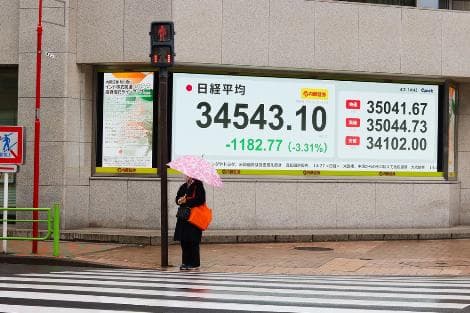
Pressured by the Middle East outlook and sluggishness in the services sector, Japan's Economy Watcher Survey index struck a four-year low in April, declining for a second-straight month, reported the Cabinet Office on Wednesday.The seasonally adjusted Economy Watcher Survey current conditions index fell to 40.8 in April from 42.2 in March, the lowest reading since the pandemic era.Readings above 50 on the index point to optimism, while below 50 in the monthly poll indicates pessimists outnumber optimists, according to the Cabinet Office."The view of the Economy Watchers indicated in this survey result is that 'the economy is showing weakness in the recent recovery movements, mainly due to the downward pressure on sentiment caused by the situation in the Middle East,'" said the Cabinet Office, in a prepared statement.The Japan Economy Watchers Survey measures the economic sentiment of workers in consumer-facing industries, such as taxi drivers, hotel staff, and restaurant employees.Employees in food and beverage industries were among the most pessimistic in April, logging a current conditions index of 34.6, down from 38.4 in March, according to official figures.Despite current qualms, the Economy Watchers forward-looking sentiment index judgment in April edged up to 39.4 from 38.7 ii March, though still in the pessimism zone, said the Cabinet Office.The April Economy Watchers survey results are roughly in line with other recent official reports on the Japanese economy.For example, in late April the Bank of Japan revised downwards its forecast for growth of the nation's gross domestic product (GDP) in fiscal 2026 (started April 1) to 0.5% from the previous 1%, citing Middle East pressures.The Economy Watchers survey contacts about 2,000 frontline service-sector employees each month, and is conducted from the 25th to the 30th of each month, according to the Cabinet Office.

Nikkei 225
Asia

Market Chatter: OECD Sees BOJ Policy Rate Reaching 2% by 2027

The Organisation for Economic Co-operation and Development (OECD) expects the Bank of Japan's policy rate to reach 2% by the end of 2027, a more hawkish outlook than forecasts from many economists and global institutions, Bloomberg reported Wednesday.In its economic survey released Wednesday, the OECD said Japan's current policy rate remains near the lower end of the neutral range, assuming inflation stays around the BOJ's 2% target. It said the central bank should continue raising rates gradually as domestic demand remains firm, according to the report.OECD Secretary-General Mathias Cormann said the pace of normalization could accelerate as Japan's economic equilibrium becomes clearer, while stressing the BOJ is not yet materially behind the curve on inflation, the report said.The 2% projection is above estimates from the International Monetary Fund and market economists, many of whom expect the tightening cycle to peak near 1.5%. OECD officials attributed the difference to a more optimistic view of Japan's growth potential, according to the report.The report also urged Japan to strengthen fiscal buffers through gradual consumption tax increases and called for broader labor participation, including from women, older workers and foreign employees, to address worsening labor shortages, the report said.(Market Chatter news is derived from conversations with market professionals globally. This information is believed to be from reliable sources but may include rumor and speculation. Accuracy is not guaranteed.)

Nikkei 225
Asia

Japan Shares Rise on BOJ Rate Hike Expectations

Japanese shares ended higher on Wednesday after the OECD projected the Bank of Japan's (BOJ) policy rate could rise to 2% by the end of 2027, reinforcing expectations of a sustained monetary-tightening cycle.The Nikkei 225 rose 0.8%, or 529.54 points, to close at 63,272.11.The OECD said the Japanese central bank's policy rate remains near the low end of the economy's neutral range and urged gradual rate hikes as inflation stays around 2% and demand continues to outpace supply.OECD Secretary-General Mathias Cormann said the pace of policy normalization could accelerate as Japan's economic equilibrium becomes clearer, though he said the BOJ was not yet "behind the curve."The OECD projected the BOJ's policy rate could reach 2% by end-2027 as the central bank continues unwinding monetary easing toward a neutral rate estimated at 1.1% to 2.5%.In economic news, Japan's current account surplus widened 29.1% year over year to 4.682 trillion yen in March, driven by higher primary income and a wider goods surplus.Japan's bank lending growth accelerated to 5.4% year over year in April, led by solid loan expansion at major banks and continued strength at regional lenders.On the corporate front, Bandai Namco (TYO:7832) rose 5% after reporting stronger fiscal 2026 profit and sales growth, driven by robust demand for its Gundam franchise and Toys and Hobby business.Tsugami (TYO:6101) climbed 7% after its China segment profit jumped 39% year over year on stronger revenue growth. Meanwhile, GNI Group (TYO:2160) advanced 9% after its liver fibrosis drug F351 was accepted for regulatory review in China with priority review status.

Nikkei 225TYO:2160TYO:6101TYO:7832
International

Japan's Current Account Surplus Expands 29% in March

Japan reported a current account surplus of 4.682 trillion yen in March, up 29.1% from 3.625 trillion yen a year earlier, preliminary data released by the Ministry of Finance on Wednesday showed.That figure was higher than the consensus estimate for a surplus of 3.879 trillion yen and the 3.933 trillion yen surplus in February.Exports grew 11.7% year over year to 10.822 trillion yen from 9.691 trillion yen, and imports climbed 10% to 9.992 trillion yen from 9.079 trillion yen a year before, the report said.The goods account surplus widened 36% to 830.5 billion yen from 611.3 billion yen in the prior year, and the primary income surplus jumped 20.8% to 4.631 trillion yen from 3.833 trillion yen, the report said.

Nikkei 225
Japan March Current Account Surplus Widens 29% in March on Strong Overseas Investment
US Markets

Japan March Current Account Surplus Widens 29% in March on Strong Overseas Investment

Japan posted a current account surplus of 4.682 trillion yen in March, up 29% from 3.625 trillion yen a year earlier, as strong overseas investment income continued to offset a deficit in services trade, data from Japan's Ministry of Finance and the Bank of Japan showed on Wednesday.The goods and services balance recorded a surplus of 572.80 billion yen in March, up 0.2% from a surplus of 571.60 billion yen a year earlier. The goods account posted a 35.9% increase in surplus to 830.50 billion yen as exports rose 11.7% to 10.822 trillion yen from 9.691 trillion yen a year earlier, while imports increased 10% to 9.992 trillion yen from 9.079 trillion yen.The services balance remained in deficit at 257.80 billion yen, wider by 548% from the 39.80 billion yen deficit recorded a year earlier. Primary income, which reflects returns on overseas investments, rose to a surplus of 4.631 trillion yen in March from 3.833 trillion yen a year earlier. The increase was driven mainly by direct investment income and portfolio investment income.Secondary income posted a deficit of 522.00 billion yen, narrower than the 778.90 billion yen deficit recorded a year earlier. The capital account showed a deficit of 69.60 billion yen in March. The financial account recorded a balance of 4.308 trillion yen, while net errors and omissions stood at negative 304 billion yen.The data comes as private-sector members of Japan's key economic advisory panel urged the Bank of Japan to proceed cautiously with monetary policy normalization, warning that prolonged geopolitical tensions in the Middle East could strain funding conditions for smaller firms.The proposals, submitted to the Council on Economic and Fiscal Policy, called for close monitoring of inflation expectations and liquidity conditions even as the central bank signals the possibility of near-term rate hikes.The members noted that while no clear signs of funding stress have emerged among small and mid-sized firms, higher energy costs and supply disruptions could increase financing needs. Bank of Japan data showed commitment line contracts rose by 2.5 trillion yen in March, the largest monthly increase since the pandemic period, underscoring precautionary cash buildup among companies.The panel also stressed closer coordination between fiscal and monetary authorities and urged broader measures of fiscal assessment beyond the primary balance as Japan navigates inflation pressures, currency weakness and external risks.

Nikkei 225

Showing 521-540 of 729

Track with the FINWIRES app suite