FINWIRES · TerminalLIVE
FINWIRES

WaFd Agrees to $3.9 Billion Reverse Merger Deal With EverBank Financial

By
WaFd Agrees to $3.9 Billion Reverse Merger Deal With EverBank Financial

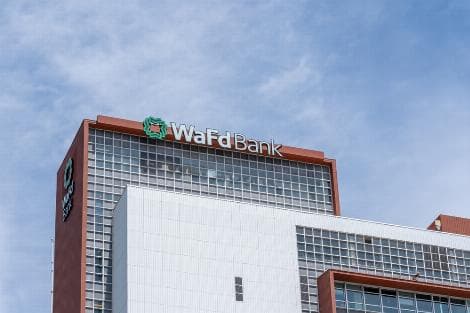
WaFd (WAFD) shares were up early Tuesday after it agreed to combine with private financial holding company EverBank Financial in a reverse merger transaction worth $3.9 billion.

EverBank Financial, the parent company of specialty bank EverBank, will merge with and into WaFd, which owns WaFd Bank, according to a late Monday statement. WaFd's stock gained 2.7% in the most recent premarket activity.

Upon completion of the transaction, WaFd will continue as the publicly traded financial holding company. It will be renamed EverBank Financial, and its shares will trade on Nasdaq under the ticker EVBK. WaFd Bank will also merge with and into EverBank, according to the companies.

"The combination of EverBank and WaFd Bank will open many new opportunities for nationwide growth and financial performance," EverBank Financial Chief Executive Greg Seibly said in the statement. "By joining together, we'll leverage our existing scalable consumer and commercial banking platforms to deliver high-value products and services to clients across the country."

The transaction, which requires approval from WaFd's shareholders and clearance from regulators, is expected to complete early next year. Following completion, EverBank Financial's investors will own roughly 59.2% of the combined company on a pro forma basis, while WaFd shareholders will hold the remaining 40.8% stake.

The combined bank is expected to generate about 29% in per-share earnings accretion in 2027 for WaFd shareholders, according to the statement. The lenders also anticipate more stable funding and faster growth of WaFd's wealth management platform.

The merger is expected to "deliver improved returns for our shareholders," WaFd CEO Brent Beardall said. "Both banks bring exceptional credit quality and strong capital to the partnership."

Beardall will serve as president of the combined entity, while Seibly will be CEO.

During an earnings call in July, Beardall said he expected banking-sector merger and acquisition activity to increase over the next two years amid a difficult operating environment. He said at the time that WaFd was "always looking at opportunities."

PNC Financial Services (PNC) agreed to buy FirstBank Holding for $4.1 billion in September last year, while Fifth Third Bancorp (FITB) announced a $10.9 billion deal to acquire Comerica (CMA) in October.

Related Articles

Fears of Another Interest Rate Hike Batter Australian Consumer Confidence
US Markets

Fears of Another Interest Rate Hike Batter Australian Consumer Confidence

Fears over a further increase in borrowing costs are unnerving Australians, with a decline in two measures of consumer confidence reflecting those concerns in addition to continued cost-of-living pressures.The Westpac-Melbourne Institute consumer sentiment index fell to 84.4 in September from 88.9 in the previous month, taking views back toward "deeply pessimistic" territory seen earlier this year, Westpac said Tuesday.A Westpac index tracking consumer interest rate expectations rose more than 7% to 170.4 in September, as around 64% of consumers now believe mortgage rates will rise further over the next 12 months, up from 59% in August, Westpac said.Higher fuel costs also weighed on sentiment, as Australian pump prices again rose above AU$2 per liter for the first time since April following the end of a temporary measure that halved fuel excise tax. The bank's survey further pointed to unease over job security, particularly among construction and hospitality workers.A separate gauge from ANZ-Roy Morgan mirrored some of those findings, showing consumer confidence falling 3 points last week to 71.9, the lowest level since late July.Both surveys follow a stronger-than-expected monthly consumer price index reading in July and more recent gross domestic product data that showed Australia's economy growing slightly below potential. The prospect of another rate hike this year combined with the GDP data may have contributed to weaker sentiment, ANZ said.ANZ still expects the Reserve Bank of Australia to raise its official cash rate by 25 basis points in November. While Westpac also acknowledged the increased likelihood of a future rate hike, it said the central bank is unlikely to move at its September meeting based on one monthly inflation read alone, especially as the next inflation update is due a day after that meeting.

ASX 200
Japan Upgrades Second-Quarter GDP Growth to 1.4% on Milder CapEx Decline
US Markets

Japan Upgrades Second-Quarter GDP Growth to 1.4% on Milder CapEx Decline

Japan's economy performed better than the government initially estimated in the second quarter of 2026, with businesses pulling back on spending by less than initially reported.The economy grew at an annualized rate of 1.4% in the second quarter, versus the initial 1.1% estimate, according to figures from the Cabinet Office on Tuesday.While the latest print beat the consensus forecast of 1.1%, according to Trading Economics, it still softened from the revised 1.8% growth in the first quarter.The improvement came as capital expenditure fell at a softer rate than previously estimated at 0.9% versus 1.2%.Overall private consumption was flat, matching the earlier estimate, while public consumption fell 0.8%, also unchanged from the previous data.Trade also did its part to keep the headline number positive, contributing 0.5% to the overall annualized GDP growth. Exports of goods and services rose 0.4% in Q2, softer than the preliminary estimate of 0.5%, while imports fell at a sharper-than-expected rate of 1.7% versus 1.5% previously.Elsewhere, government spending was revised modestly higher at 1.7% from 1.6%, while public investment came in weaker than first reported, falling 0.5%, versus the previous 0.1% estimated decline.The revised figures arrive over a week before the Bank of Japan's Sept. 17-18 policy meeting, with analysts expecting a 25 basis-point rate hike to 1.25%, according to Trading Economics.At its July meeting, the central bank held its short-term policy rate steady at 1%, leaving borrowing costs at their highest point since September 1995 following a 25 basis-point hike earlier in June.Last week, BOJ policy board member Hajime Takata urged the central bank to adopt a data-dependent approach to future interest rate hikes, calling on policymakers to assess domestic financial conditions and developments in overseas economies.

Nikkei 225
Beijing Unveils 360 Billion Yuan Funding Plan in 'Clear Policy Focus' to Bolster Financial System
US Markets

Beijing Unveils 360 Billion Yuan Funding Plan in 'Clear Policy Focus' to Bolster Financial System

Major state-owned financial institutions in China announced plans to raise or receive 360 billion yuan in total, a move that analysts said should boost the country's financial system resilience.Xinhua reported Monday that eight central financial companies are included in the plan. In separate Sunday filings, Agricultural Bank of China (HKG:1288, SHA:601288) said it is targeting up to 160 billion yuan, Industrial and Commercial Bank of China (HKG:1398, SHA:601398) will raise no more than 100 billion yuan, and People's Insurance Company or PICC (HKG:1339, SHA:601319) is looking at a maximum of 15 billion yuan."China's planned capital injection into several financial institutions owned by the central government underscores ongoing state support for the financial sector and a clear policy focus on strengthening financial-system resilience," Fitch said in a note."The Ministry of Finance-led support should help improve capital buffers, enhance loss-absorption capacity and reinforce these institutions' ability to fund policy priorities and support broader economic growth."Others that will receive funding under the latest support package also include The Export-Import Bank of China, China Export & Credit Insurance, China Life Insurance (HKG:2628, SHA:601628), China Taiping Insurance Group, and China Reinsurance (Group), the rating agency noted.AgBank, ICBC and PICC said the general mandates will see China's Ministry of Finance enter into separate share subscription agreements with a five-year lock-up period. New shares will be issued and listed in Shanghai.While insurance group PICC said proceeds will be used solely for capital replenishment, the two banking majors earmarked the funds to be raised to bolster their common equity tier 1 capital. The proposed transactions remain subject to certain conditions and approvals.

HKG:1288HKG:1339HKG:1398SHA:601288SHA:601319SHA:601398