FINWIRES · TerminalLIVE
FINWIRES

Trump-Xi Summit Caps Off With $51B Agricultural Commitment, 200 Boeing Jet Order

By
Trump-Xi Summit Caps Off With $51B Agricultural Commitment, 200 Boeing Jet Order

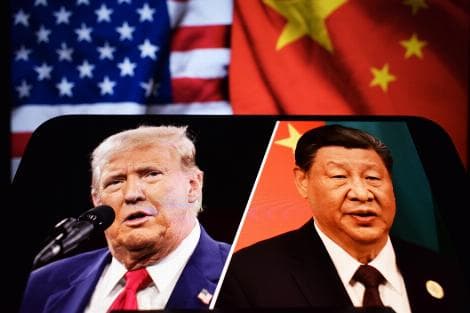
China has agreed to purchase U.S. agricultural goods worth $17 billion per year from 2026 to 2028 as part of agreements brokered during President Donald Trump's visit to Beijing last week, the White House said in a fact sheet published Sunday.

Trump wrapped up his two-day meeting with Chinese President Xi Jinping on Friday, extending an invitation for Xi to visit Washington in September.

The new agricultural commitments, which will total roughly $51 billion over the next three years, build on China's October 2025 pledge to purchase at least 25 million metric tons of U.S. soybeans. Additional agreements include restoring market access for U.S. beef facilities by renewing licenses that had lapsed during the 2025 tariff retaliations.

Asifr from agriculture, Beijing also committed to purchasing 200 U.S.-made Boeing aircraft.

China also pledged to address supply chain constraints and restrictions surrounding rare earths and critical minerals such as yttrium, scandium, neodymium, and indium. However, specific implementation details were not disclosed.

Following the summit, China's Ministry of Commerce said "both sides should continue to implement the results of previous consultations and reach a positive consensus on relevant tariff arrangements."

Financial markets reacted coolly to the summit. Lynn Song, ING's chief economist for Greater China, said, "Many market participants were left rather underwhelmed after the much-hyped Trump visit to China concluded, with equities and the CNY both softening on Friday as the summit ended without any major surprises."

Despite initial optimism surrounding the last-minute inclusion of Nvidia CEO Jensen Huang in the U.S. business delegation, the summit produced no concrete breakthroughs on artificial intelligence chip exports.

"The lack of any concrete announcements at the end of Trump's China trip would likely cause a selloff in China AI stocks," analysts from Jefferies said in a note to clients. "This trip likely laid the groundwork for deals to take place in the next three to six months, especially as Xi is visiting the U.S. in September."

To stabilize bilateral trading relations, the two nations plan to establish a "Board of Trade." According to the White House, the body will oversee "bilateral trade across non-sensitive goods" and serve as a "government-to-government forum for discussing investment-related issues."

However, Jefferies noted that the Board of Trade is unlikely to lift the U.S. investment ban against certain Chinese companies. Instead, it will "govern less sensitive investment issues," such as Contemporary Amperex Technology or CATL's (SHE:300750, HKG:3750) plan to build a battery plant in the U.S.

Commenting on the Board of Trade mechanism, the Commerce Ministry said: "The two sides will discuss issues such as tariff reductions on relevant products through the Trade Council and have agreed in principle to reduce tariffs on products of equal size of concern to each other."

Equities in Shanghai and Shenzhen opened lower on Monday as post-summit momentum faded amid unmet expectations for a breakthrough.

"We believe the Trump-Xi summit is broadly neutral for HK/China stocks, with the outcome representing a stabilization of relations rather than any transformational change," analysts at Nomura said.

Economists at Bank of America said in a Friday note that the bilateral meetings underscored a mutual "commitment to step up communications" rather than delivering tangible breakthroughs.

On the geopolitical front, however, the White House reported that both sides affirmed shared stances on several security positions, including opposition to Iran's nuclear program, the reopening of the Strait of Hormuz, and the denuclearization of North Korea.

Related Articles

Nasdaq, S&P 500 Retreat From Record Highs as Yields Surge Amid Inflation Woes
US Markets

Nasdaq, S&P 500 Retreat From Record Highs as Yields Surge Amid Inflation Woes

The Nasdaq Composite and the S&P 500 fell from record highs as inflation concerns pushed Treasury yields higher.The Nasdaq tumbled 1.5% to 26,225.1, while the S&P 500 dropped 1.2% to 7,408.5. The Dow Jones Industrial Average lost 1.1% to 49,526.2. Barring energy, all sectors ended in the red, led by materials' 2.7% slump.The S&P 500 advanced 0.1% this week, marking its seventh consecutive weekly advance. The Nasdaq logged a weekly loss of 0.1% after a streak of six weekly gains. The Dow recorded a weekly loss of 0.2%.US Treasury yields surged, with the 10-year rate last up 14 basis points at 4.60% and the two-year rate rising 8.7 basis points to 4.08%.The headline consumer price index is expected to average 6% in the second quarter, according to a poll of economists by the Federal Reserve Bank of Philadelphia. That's well above the 2.7% rate pegged in the previous survey, which was published in March.Earlier this week, official data showed that consumer inflation accelerated to 3.8% year over year in April, the highest print since May 2023. Energy prices rose nearly 18%, the highest since September 2022.West Texas Intermediate crude was last up 4.7% at $105.89 a barrel, while Brent climbed 3.6% to $109.57.Talks between US President Donald Trump and his Chinese counterpart, Xi Jinping, this week failed to improve the prospects of a US-Iran peace deal.RBC Capital Markets sees no imminent diplomatic breakthrough."There seems to be an emerging consensus that the Strait of Hormuz will reopen in June because the cost of continued closure will be too high," RBC said in a note emailed Friday. "We are very skeptical of a June grand reopening."In economic news, US industrial production rebounded more than projected in April, buoyed by the manufacturing and utilities categories, Federal Reserve data showed."Besides supportive fiscal policy, the (artificial intelligence) buildout will continue to lift production of computers and electronics, while an inventory restocking cycle will support new orders growth for factories," Oxford Economics said in a note.New York manufacturing activity grew at the fastest pace in more than four years this month amid robust new orders, the New York Fed reported.Gold was last down 3.1% at $4,540.30 per troy ounce, while silver slid nearly 11% to $76.21 per ounce.

Dow JonesNasdaq CompositeS&P 500
Inflation Seen at 6% This Quarter, Above 2% in Long Term, Philadelphia Fed Survey Shows
US Markets

Inflation Seen at 6% This Quarter, Above 2% in Long Term, Philadelphia Fed Survey Shows

US annual consumer inflation is expected to reach 6% in the ongoing quarter and remain above 2% in the long term, a poll of economists by the Federal Reserve Bank of Philadelphia showed Friday.The headline consumer price index is expected to average 6% in the second quarter, according to the Fed branch's latest quarterly Survey of Professional Forecasters. That's well above the 2.7% rate pegged in the previous survey, which was published in March.In the years through 2035, the forecasters now project headline CPI at 2.40%, up from the 2.30% rate expected previously, the Friday survey showed.Earlier this week, official data showed that consumer inflation accelerated to 3.8% year over year in April, the highest print since May 2023. Energy prices rose nearly 18%, the highest since September 2022.Energy prices have soared as the Strait of Hormuz remains largely shut following the US-Israel war with Iran that started at the end of February. The strait is the world's most important chokepoint for crude flows. US President Donald Trump recently rejected Iran's counteroffer to end the war, though a fragile ceasefire between the two countries appears to be holding.Economists now expect 2026 headline CPI at 3.5%, compared with the previous forecast of 2.6%, the Philly Fed report showed Friday. Full-year core CPI -- which excludes the volatile food and energy components -- is projected at 2.9%, up from 2.6% previously.Late last month, the central bank's Federal Open Market Committee kept its policy rate unchanged for a third consecutive meeting, saying the Middle East conflict is fueling uncertainty about the US economic outlook.The world's largest economy is now projected to grow 2.2% this year, slower than the previous estimate of 2.5%, according to the Philly Fed's survey of 33 economists."The forecasters see the risk of a contraction in real (gross domestic product) this quarter at 17.9%, down from the previous estimate of 20.9%," according to the report. "However, they have increased their probability estimates for negative growth for the following three quarters, compared with their estimates in the survey of three months ago."Economists now forecast 2026 unemployment rate at 4.4%, down from the previously projected 4.5%, the survey showed.

Oil Rises as US-Iran Deal Uncertainty Persists Following Trump-Xi Summit
US Markets

Oil Rises as US-Iran Deal Uncertainty Persists Following Trump-Xi Summit

Crude oil prices rose Friday as talks between President Donald Trump and his Chinese counterpart, Xi Jinping, failed to improve the prospects of a US-Iran peace deal.Brent advanced 3.4% to $109.28 per barrel, while West Texas Intermediate crude futures were last up 4.2% at $105.37.Trump and Xi met in Beijing this week, with trade and the Iran war key parts of the agenda.Trump told Fox News on Thursday that Xi offered to help ensure navigation through the Strait of Hormuz, a key oil chokepoint. China didn't publicly confirm or deny that claim."China always believes that dialogue and negotiation is the right way forward, and the use of force is a dead end," China's Foreign Ministry spokesperson Guo Jiakun said in a statement Friday regarding the Iran war. "Now that the door of dialogue has been opened, it should not be shut again."Trump reportedly said China agreed to purchase more oil from the US. When asked about that, Jiakun said "China stands ready to work with all sides to ensure global energy security and keep global industrial and supply chains stable."A fragile ceasefire between Washington and Tehran appears to be holding, though the two sides are yet to finalize a framework on a deal despite a series of talks. Trump recently rejected Iran's counteroffer to end the war."I am not gonna be much more patient," Trump told Fox News. "They should make a deal."RBC Capital Markets is skeptical of an imminent diplomatic breakthrough."There seems to be an emerging consensus that the Strait of Hormuz will reopen in June because the cost of continued closure will be too high," RBC said in a note emailed Friday. "We are very skeptical of a June grand reopening."Earlier in the week, the International Energy Agency projected a sharper decline in global oil demand this year than previously expected as the Middle East conflict drives up energy prices. Separately, the Organization of the Petroleum Exporting Countries lowered its oil demand growth forecast for 2026.