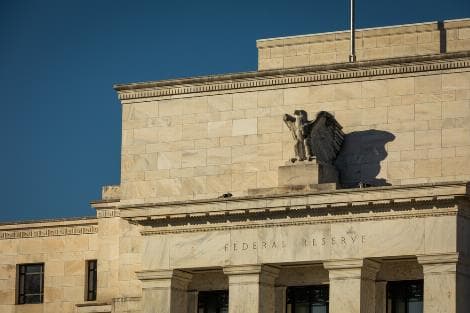
The Federal Reserve is likely to maintain interest rates stable for the rest of the year, despite its recent hawkish monetary policy statement, as inflation looks set to ease, Morgan Stanley said Friday in a report.
Last week, the US central bank's Federal Open Market Committee kept interest rates unchanged, marking its fourth consecutive pause after last year's three 25-basis-point cuts amid concerns about the labor market. Fed policymakers also decided to remove the so-called easing bias from its statement, while raising its interest rate expectations through 2028.
Citing several factors for its "more sanguine" inflation outlook compared with the average Fed participant, Morgan Stanley is projecting month-over-month core personal consumption expenditure inflation and consumer price index inflation to ease to 0.2% or below in coming months. On Thursday, government data showed core PCE inflation -- the Fed's preferred inflation metric -- held steady at 0.3% in May.
"We believe tariff pass through is ending, paving the way for substantial disinflation in core goods over the next year, and the recently signed (memorandum of understanding) between the US and Iran has helped push oil prices back toward pre-conflict levels," Morgan Stanley Chief US Economist Michael Gapen wrote. "In addition, we look for further moderation in shelter inflation and some payback from residual seasonality into year end."
The investment bank has projected US headline and core PCE inflation of 3.2% and 3.0%, respectively, this year, while the Fed is looking at 3.6% and 3.3%, based on on its latest Summary of Economic Projections, or SEP.
"We think the Fed may be overstating inflation pressures since forecasts were likely formed before the MOU took hold," Gapen said. The Fed participants' latest inflation forecasts look "too high in light of the subsequent decline in energy prices," he said.
West Texas Intermediate crude oil was down 3.1% at $69.68 a barrel intraday Friday, while Brent fell 3.7% to $72.50. The benchmarks were on track for weekly declines of more than 9%.
The FOMC's latest SEP document showed the median federal funds rate at 3.8% at the end of 2026, up from 3.4% in March, implying a potential rate hike. The 2027 and 2028 outlooks were revised higher to 3.6% and 3.4%, respectively, from 3.1% previously projected for both years.
"We believe most of the nine dots projecting rate hikes this year are Reserve Bank presidents that may not be voters; we think it is likely that the majority of voters on the committee prefer the status quo policy setting despite the evolution of the outlook," Gapen said.
Morgan Stanley also expects the labor market to cool down, following recent outsized payroll gains.
"In the labor market, we expect recent payroll gains to moderate," Gapen said. "We project increases of (50,000 to 60,000 jobs) per month on average over the summer (total nonfarm and private), which should keep the unemployment rate roughly steady near current levels."