
FINWIRES · TerminalLIVE
FINWIRES

Australian Household Spending Falls 1.1% in April Amid Travel Pullback

By
Australian Household Spending Falls 1.1% in April Amid Travel Pullback

Household spending in Australia dropped in April as people scaled back on travel amid the Middle East crisis.

Spending fell 1.1%, representing a downturn from the 1.6% rise recorded in March, according to data published by the Australian Bureau of Statistics (ABS) on Thursday.

The decline was steeper than the market's estimate of a 0.5% drop, but smaller than the 1.3% and 1.4% decreases forecasted by ANZ and the Commonwealth Bank, respectively.

The downturn was largely attributed to a 4.7% drop in transport spending, with air travel being the biggest contributor. Consumers reduced their travel due to uncertainties surrounding the conflict in Iran, which drove up airfares and jet fuel costs.

However, fuel spending eased compared with March after the Federal Government halved the fuel excise duty, a measure that took effect on April 1.

"The fuel excise discount provided some immediate relief to household budgets. We also saw spending on public transport ease in states offering free travel, particularly Victoria and Tasmania," ABS head of business statistics Tom Lay said.

The ABS noted that "a rise in new vehicle sales provided a partial offset to the broader transport decline."

"Our broader view remains that consumers have been broadly resilient to the fuel shock and rising interest rates so far, but there are emerging signs of softness," Commonwealth Bank economist Harry Ottley said in a note.

"The weakness in spending - we estimate the ex-fuel spend over the past six months to be only around 1% higher - does sit reasonably consistently with the weakness in consumer confidence, the low level of auction clearance rates and slightly better than expected inflation data for April. The latter suggests that firms might be struggling to pass price and cost increases through to consumers," Adam Boyton, ANZ's head of Australian economics, said in a separate note.

Spending on other commodities also fell, with food and apparel dipping 1.3% and 2.2%, respectively, according to the ABS. Meanwhile, spending on services increased, with health, as well as hotels, cafes, and restaurants, each rising by 0.5%.

Related Articles

Fonterra Maintains 2025-2026 Milk Price, Upgrades Full-Year Forecast on Robust Fiscal Third-Quarter
US Markets

Fonterra Maintains 2025-2026 Milk Price, Upgrades Full-Year Forecast on Robust Fiscal Third-Quarter

Fonterra Co-operative Group (NZE:FCG) has maintained a robust farmgate milk price forecast for the 2025-2026 season after reporting strong fiscal third-quarter earnings despite global supply chain disruptions caused by the Middle East conflict.The cooperative held its farmgate milk price midpoint at NZ$9.70 per kilogram of milk solids, while narrowing its forecast range to between NZ$9.60 and NZ$9.80 per kgMS, down from a previous spread of NZ$9.40 to NZ$10.00.Prices have remained relatively high despite cost inflation and shipping delays stemming from the war in Iran. In March, shipments bound for the Gulf region faced delays following joint U.S.-Israeli missile strikes on Tehran."As we look ahead to next season, we expect milk collections to remain high, in line with this season. Our in-market sales teams are anticipating solid demand from across the regions despite potential volatility, and this is reflected in our opening forecast range," Fonterra CEO Richard Allen said.Looking ahead, the dairy giant announced a strong opening forecast for the 2026-2027 season, setting the farmgate milk price midpoint at NZ$9.75 per kgMS, with an initial range of NZ$8.00 to NZ$11.00.The forecast came as total operating profit for the fiscal third quarter rose year on year to NZ$1.8 billion from NZ$1.7 billion.Underlying earnings per share increased to NZ$0.57 from NZ$0.53 in the previous year.Allen noted that the cooperative's strategic focus on growing its Ingredients and Foodservice channels enabled it to return NZ$3.2 billion to shareholders. The Ingredients division capitalized on sustained protein demand from the U.S. and Europe, while the Foodservice unit delivered solid growth in both margins and sales volumes.Supported by this performance, the company raised its forecast for full-year earnings to between NZ$0.60 and NZ$0.70 per share."Looking ahead, Fonterra has strong foundations and a clear strategy to deliver value through our global Ingredients and Foodservice businesses," Allen said. "Our full-year earnings guidance reflects the strong shipment volumes expected in the final quarter of the year."

$NZE:FCG
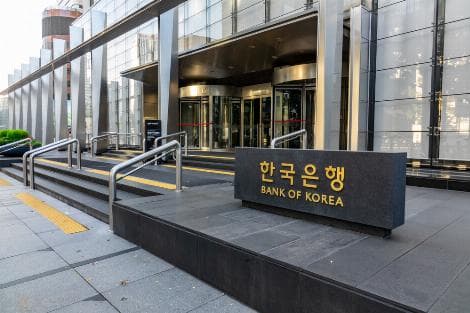
Bank of Korea Holds Interest Rates Steady, Raises Growth and Inflation Forecasts
US Markets

Bank of Korea Holds Interest Rates Steady, Raises Growth and Inflation Forecasts

The Bank of Korea left its benchmark interest rate unchanged at 2.50% on Thursday, citing heightened uncertainty surrounding the conflict in the Middle East and its potential impact on inflation and economic growth.The decision was widely expected, with 30 of 32 economists polled by Reuters forecasting the central bank would keep rates unchanged."Given the uncertainties surrounding developments in the Middle East and that their spillover effects remain high, the board judged that it would be appropriate to maintain the current level of the base rate," the central bank said in a statement.The BOK said inflationary pressures had increased due to the war, while domestic growth had strengthened more than previously expected, driven by robust exports and semiconductor-related investment.Five board members supported keeping rates unchanged, while two members voted for a 25-basis-point increase to 2.75%, signaling growing concern over inflation risks.The bank's updated dot plot also pointed to a more hawkish policy outlook, with most board members projecting rates to rise toward 3% over the next six months, while two members saw rates reaching 3.25%.The central bank said rising global oil prices and supply constraints linked to the Middle East conflict were expected to push inflation higher in the coming months.The BOK raised its economic growth forecast for this year to 2.6% from 2% projected in February, supported by strong semiconductor exports, resilient consumption, and supplementary fiscal spending.Consumer price inflation is now projected at 2.7% this year, up from the previous forecast of 2.2%, while core inflation is expected at 2.4%, compared with the earlier estimate of 2.1%."Inflation appears to have more room to rise, so the likelihood of the Bank of Korea taking action in July looks fairly high," Cho Yong-gu, a fixed-income strategist at Shinyoung Securities, was quoted as saying by Bloomberg News.The meeting marked the first policy decision chaired by Governor Shin Hyun Song, who was scheduled to hold his first press conference later Thursday."The BOK's economic outlook itself seems relatively reasonable and free of major surprises, so the focus now will likely shift to the dot plot, any dissent favoring a hike, and the governor's qualitative comments on guidance," Cho was quoted by Bloomberg News as saying.The BOK's hawkish projections reinforced expectations for further tightening later this year."We expect the BOK will hike its policy rate to 2.75% at the next meeting in July, followed by another rate hike in October, pushing the rate toward 3.00% by the end of the year," Stephen Lee, an economist at Meritz Securities in Seoul, said, according to Reuters.

$^KS11
Chipmaker CXMT Wins Approval for China's Largest IPO Since 2022
US Markets

Chipmaker CXMT Wins Approval for China's Largest IPO Since 2022

ChangXin Memory Technologies has received approval from the Shanghai Stock Exchange to proceed with an initial public offering, targeting 29.5 billion yuan in proceeds, which would make it the largest IPO in China in four years.The Shanghai bourse's Listing Review Committee on Wednesday noted that CXMT "meets the issuance conditions, listing conditions, and information disclosure requirements" for an IPO.The chipmaker plans to list 10.6 billion shares on the STAR Market board, accounting for at least 10% of its share capital post-issuance.CXMT has agreed to grant underwriters an overallotment option to issue up to an additional 15% of the shares in the offering.China International Capital Corporation and CITIC Securities are serving as lead underwriters.Based on its IPO target size, the deal would mark the largest in China since CNOOC's (SHA:600938, HKG:0883) 32.3 billion yuan Shanghai IPO in 2022. It would also be the biggest in Asia since Contemporary Amperex Technology or CATL's (SHE:300750, HKG:3750) HK$41 billion Hong Kong IPO last year.CXMT describes itself as the world's fourth-largest supplier of dynamic random access memory (DRAM). The company competes with South Korea's Samsung Electronics (KRX:005930) and SK Hynix (KRX:000660), and US-based Micron Technology. They collectively control 90% of the DRAM market, according to The Wall Street Journal.DRAM is a chip that serves as a key component for processors, including those used for artificial intelligence models.The company supplies its products to domestic clients like Alibaba Holdings (HKG:9988), ByteDance, Tencent Holdings (HKG:0700) and Xiaomi (HKG:1810).Of the total proceeds, CXMT plans to use 13 billion yuan to upgrade its DRAM technology, 9 billion yuan for DRAM research and development, and 7.5 billion yuan to upgrade its production line."After years of development, the company has broken through key core technologies in DRAM and successfully achieved independent R&D, design, and commercial mass production of its products, filling a long-standing gap in the global market for DRAM products from mainland China," according to a translated text of CXMT's IPO prospectus.The IPO comes as CXMT continues to bank on the strong global demand for chips amid the AI boom. For the first quarter ended March 31, CXMT swung to an attributable net profit of 24.8 billion yuan from an attributable net loss of 1.56 billion yuan a year earlier. Revenue surged 719% to 50.8 billion yuan from 6.2 billion yuan.The company expects to book up to 57 billion yuan in attributable profit for the first half of 2026, versus an attributable net loss of 2.33 billion yuan a year prior. Revenue is forecast to jump by up to 677% from a year earlier to up to 120 billion yuan.Ao Fei, managing director at Beijing Xinhan Capital, told Bloomberg that CXMT's "position in the industry and its strategic importance to the nation speaks for itself.""CXMT is the reason China has been able to get a foothold in DRAM, arguably the most critical memory segment powering the AI revolution.""This is a national champion that has catalyzed China's entire semiconductor supply chain, serves as a training ground for the next generation of talent, and has elevated the industry to a new frontier," Ao reportedly said."You could argue that ChangXin today occupies the same pivotal position that CATL held at the time of its listing."Meanwhile, Dong Shaopeng, a senior research fellow at the Chongyang Institute for Financial Studies, Renmin University of China, told China's Global Times that the Shanghai bourse's approval of CXMT's listing follows the outcome of policy guidance, industrial efforts and coordinated support from the financial system."Against this backdrop, continued breakthroughs in China's semiconductor industry could bring structural adjustments to the global chip market landscape," Dong was quoted by the Global Times as saying.CXMT's Shanghai IPO also comes amid an influx of new listings in mainland China and Hong Kong. Total funds raised from A-share IPOs in the first quarter of 2026 rose 8% year over year to 27.4 billion yuan, according to data from KPMG.

$^SSEC$HKG:0700$HKG:0883$HKG:1810$HKG:3750$HKG:9988$KRX:000660$KRX:005930$SHA:600938$SHE:300750