FINWIRES · TerminalLIVE
FINWIRES

Vietnam Posts Record High Trade Deficit in May as US Sanctions Loom

By
Vietnam Posts Record High Trade Deficit in May as US Sanctions Loom

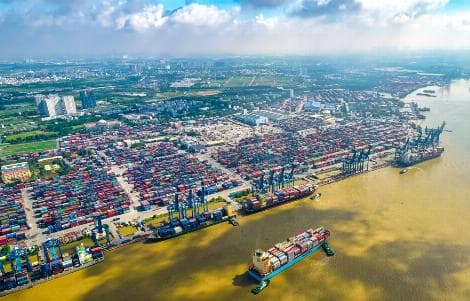
Vietnam's trade deficit widened in May to a record high as imports surged 34% amid the ongoing conflict in the Middle East and possible tariffs from the U.S.

The Southeast Asian country's trade deficit reached $5.21 billion in May, wider than the $3.28 billion recorded in the previous month, the National Statistics Office said Wednesday.

The figure was the largest trade deficit since the beginning of records in 1990, and was worse than Trading Economics' forecast of a $3.41 billion deficit and Bloomberg economists' $3.98 billion deficit forecast.

The domestic sector logged a trade deficit of $20.76 billion in the first five months, while the foreign investment sector, including crude oil, logged a $6.96 billion surplus.

Imports surged to $52.14 billion during the month, higher than the $49.48 billion seen in the previous month.

For the first five months of 2026, imports surged 31% to $229.46 billion, led by purchases from China with $92.6 billion, the NSO said.

Exports grew 18% year over year to $46.93 billion but were slower than Bloomberg's growth forecast of 19.7%.

For the January-May period, exports jumped 19.5% to $215.66 billion, with the U.S. as Vietnam's largest market at $69.6 billion.

The data comes as the U.S. Trade Representative's office introduced a third probe into Vietnam's intellectual property protection and enforcement and its impact on American commerce.

Trade Representative Jamieson Greer is looking to consult President Donald Trump for any "responsive action" regarding Vietnam, the office said May 29.

The conflict in the Middle East could also cost Vietnam's export-driven economy as crude oil prices rise, Bloomberg reported separately Wednesday.

Related Articles

Asian Banking Sector Surges Past Automobiles to Lead May Activity Growth, S&P Global Survey Finds
US Markets

Asian Banking Sector Surges Past Automobiles to Lead May Activity Growth, S&P Global Survey Finds

Most Asian business sectors expanded in May, with banking overtaking the automobile industry, according to the S&P Global Asia Sector PMI released on Wednesday.Leading the upturn for the first time in seven months, the banking sector expanded at its second-steepest rate in over five and a half years. The growth follows a previous S&P Global forecast warning that credit losses in the Asia-Pacific banking sector could surge by approximately $180 billion due to the ongoing conflict in the Middle East.The automobile sector, last month's top performer, slipped to second place, though its pace of growth remained historically high.Of the 18 sectors monitored, only forestry and paper products, alongside construction materials, recorded a contraction in new orders; however, these declines were softer than in the previous month. In contrast, the transportation sector posted the strongest surge in new orders, despite looming concerns over U.S.-Iran negotiations.Volatility persists in the energy and oil industries due to the precarious state of U.S.-Iran talks aimed at ending the Middle East conflict."Oil prices received a boost yesterday as talks between the US and Iran appeared to break down -- again. This has become a common pattern in recent months, and there are still plenty of mixed messages," ING'S Warren Patterson and Ewa Manthey said in a Tuesday note. "As a result, oil prices continue to be whipsawed by quickly changing headlines."Operating expenses increased across all 18 sectors. S&P Global highlighted that real estate recorded a renewed rise in input prices, while the chemicals sector posted the sharpest cost inflation rate.All sectors increased their selling prices except for the consumer services sector.

$^AXJO$^BSE$^HNX$^HOSE$^HSI$^JKSE$^KS11$^N225$^NSE$^NSEI$^SET$^SSEC$^SZSE$^TWII
Vietnam's Inflation Accelerates to 5.6% in May on Higher Utility, Fuel Costs
US Markets

Vietnam's Inflation Accelerates to 5.6% in May on Higher Utility, Fuel Costs

Vietnam's consumer price index rose 5.6% in May from a year earlier, according to data released by the National Statistics Office on Wednesday.Housing, electricity, water, fuel, and construction materials recorded the largest monthly increase among major categories, rising 0.96% from April.The quickening of inflation was "due to rising electricity and water prices, coupled with high demand during hot weather, as well as increases in construction material prices, rental housing prices, and gasoline prices," the statistics office said in a statement.Core inflation, which excludes volatile items, increased 4.67% from a year earlier.For the first five months of 2026, consumer prices increased 4.31% from a year earlier, while average core inflation rose 4.04%.The inflation pickup comes as higher global energy prices linked to the conflict in Iran continue to filter through transportation, services, and construction-related costs.Vietnam's Finance Ministry said in April that inflation could reach as high as 5.5% this year, with the conflict in Iran expected to be a key driver of higher consumer prices through its impact on energy and transportation costs.The outlook has also been clouded by mounting trade tensions with the United States. In late May, Washington launched a new investigation into Vietnam's intellectual property protection and enforcement practices, the third U.S. trade probe targeting the country in as many months.The investigation could pave the way for additional tariffs on Vietnamese exports, adding pressure on the export-dependent economy.Vietnam's Foreign Ministry said it hoped the U.S. would conduct an "objective and fair assessment" that fully recognizes Vietnam's efforts and achievements, according to a statementMeanwhile, Vietnam's trade deficit widened to a record $5.21 billion in May as imports surged amid rising global raw material prices and stronger demand for production inputs.

$^HNX$^HOSE
Hong Kong's Private Sector Returns to Growth in May, S&P Global Says
US Markets

Hong Kong's Private Sector Returns to Growth in May, S&P Global Says

Hong Kong's private sector returned to growth in May, supported by stronger export demand and a modest increase in new orders, S&P Global said Wednesday.The seasonally adjusted S&P Global Hong Kong SAR Purchasing Managers' Index rose to 50.4 in May from 48.6 in April.The reading moved back above the 50-point threshold that separates expansion from contraction and marked the first improvement in business conditions in three months.Business activity expanded modestly during the month, with construction emerging as the strongest-performing sector.New orders also returned to growth territory, supported by stronger overseas demand, while export orders recorded their fastest increase in three months.Some firms attributed higher sales to new product launches, although others continued to report weak domestic demand and intense competition.Usamah Bhatti, economist at S&P Global Market Intelligence, attributed the return to growth to modest increases in business activity and new orders, supported by stronger overseas demand despite ongoing weakness in local market conditions.Despite the recovery in demand, employment continued to decline as firms reported sufficient capacity to handle workloads and chose not to replace departing staff.Firms also reported a deterioration in supplier performance, with some linking delivery delays to shipping disruptions caused by the conflict in the Middle East.Cost pressures remained elevated during the month. Purchasing costs rose at the fastest pace since December 2021, driven largely by higher raw material prices, particularly fuel-related products.Many firms passed higher costs on to customers through price increases, although some offered discounts to support sales, resulting in a slower pace of output price inflation than in April.Looking ahead, firms remained pessimistic about business prospects over the next 12 months, although negative sentiment eased to a three-month low.The survey's elevated cost pressures come as Hong Kong officials expect inflation to accelerate in the coming months.Hong Kong's annual inflation rate stood at 1.7% in April, unchanged from the previous two months and the highest level since May last year.Financial Secretary Paul Chan Mo-po said the Middle East conflict has so far had only a limited impact on local inflation, citing Hong Kong's service-based economy and stable energy supplies from mainland China."Rising international oil prices will continue to feed through to consumer prices and fuel-related products," Chan told lawmakers on Monday."However, as Hong Kong is a service-oriented economy with relatively low energy dependency, and with stable energy supplies from the mainland, the external impact can be mitigated," he added.The government revised its 2026 forecasts for underlying and headline inflation last month to 2.5% and 2.6%, respectively, from 1.7% and 1.8%.

$^HSI