FINWIRES · TerminalLIVE
FINWIRES

Unitree Surges 460% in Blockbuster Shanghai Debut as Investors Bet Heavily on Robotics

By
Unitree Surges 460% in Blockbuster Shanghai Debut as Investors Bet Heavily on Robotics

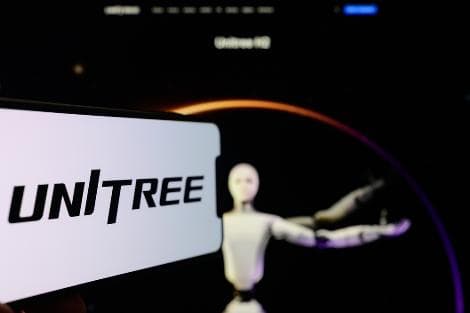
Unitree Robotics' (SHA:688836) closed 460% higher at 845 yuan during its first trading day on the Shanghai Stock Exchange on Wednesday, driven by growing investor optimism surrounding the government's push for embodied intelligence.

The robotics company opened at 1,100 yuan, representing a 629% jump from its initial public offering price of 150.80 yuan. The IPO raised 6.1 billion yuan.

Unitree's stellar performance pushed its market capitalization to 341.8 billion yuan as of market close.

The offering gathered tech and state-backed institutional participants, including AI startup DeepSeek and PetroChina (SHA:601857, HKG:0857) parent China National Petroleum Corp.

Prior to the IPO, Meituan (HKG:3690), through its entities Hanhai Information Technology, Galaxy Z and Chengdu Dragon Pearl, held a 9.65% stake in the company, according to Unitree's IPO filings. Following the IPO, they collectively held a combined 8.7% stake now valued at 29.7 billion yuan.

Other strategic investors include Tencent Holdings (HKG:0700) through Tencent Technology and Alibaba Group (HKG:9988) through affiliate Hangzhou Haoyue.

Unitree's listing has established a "publicly available valuation benchmark from the A-share market for the first time," according to trade body China Mobile Robot Alliance (CMRA).

Analysts at Nomura said Unitree could reach its potential due to its rapid product iteration and continuous innovation, putting the robotics company at pole position as demand emerges.

In the first half of 2026, Unitree's revenue surged 48.5% to 1.15 billion yuan, while attributable net profit stood at 274 million yuan, reversing the 32 million yuan loss a year earlier.

"Unitree was previously best known for its quadruped robots, but judging from its revenue and shipment structure, the company is rapidly shifting towards humanoid robots," said CMRA.

Under China's 15th Five-Year Plan, the government identifies embodied intelligence as a new economic growth point. Beijing has already set out an action plan for humanoid robots and embodied intelligence real-scenario training, according to Xinhua.

Related Articles

Evolution Mining's Fiscal 2027 Production Guidance Meets Estimate at Midpoint
US Markets

Evolution Mining's Fiscal 2027 Production Guidance Meets Estimate at Midpoint

Evolution Mining (ASX:EVN) fiscal 2027 gold production guidance met estimates at the midpoint, while the gold producer increased its dividend, helped by its cash flows.The company expects fiscal 2027 gold production of 660,000 to 730,000 ounces compared with 715,000 ounces in fiscal 2026 and Jefferies' estimate of 700,000 ounces.It also expects to produce 63,000 to 70,000 tonnes of copper in fiscal 2027 compared to 66,000 tonnes in fiscal 2026 and Jefferies' estimate of 67,000 tonnes.Evolution Mining reported fiscal 2026 earnings per share of AU$0.7277 compared with AU$0.4641 last year. Analysts surveyed by FactSet expected AU$0.79 earnings per share.It posted revenue of AU$5.56 billion, up from AU$4.35 billion last year and higher than the AU$5.52 billion analysts' consensus as polled by FactSet.Chief Executive Officer Lawrie Conway attributed the results to the company's "consistent and reliable" operational delivery, and its cost and capital management.The gold producer also bumped up its final dividend to AU$0.21 per share from AU$0.13 per share last year.Jefferies said that the company continues to generate strong cash flows, which supported increased dividends to shareholders while undertaking material major capital expenditure to maintain its current production rates.

ASX:EVN
Baidu's Quarterly Profit Slumps on Lower Investment Gains; AI Cloud Growth Accelerates
US Markets

Baidu's Quarterly Profit Slumps on Lower Investment Gains; AI Cloud Growth Accelerates

Baidu (HKG:9888) reported a sharp year-over-year drop in second-quarter profit, which the Beijing-based tech company attributed to lower investment income that offset steady growth in its AI cloud business.Net income attributable to shareholders plunged 68% to 2.32 billion yuan from 7.32 billion yuan, with earnings per share shrinking to 5.74 yuan from 20.35 yuan, according to its after-hours Hong Kong bourse filing on Tuesday.Baidu attributed the drop to a decrease in fair value gain from long-term investments and higher net foreign exchange losses linked to exchange rate fluctuations.Revenue slipped 4% year over year to 31.3 billion yuan, weighed down by lower revenue across its core Baidu General Business and online video streaming platform iQIYI.Cost of revenue rose year over year to 19.1 billion yuan on the back of higher traffic acquisition costs and costs related to its AI Cloud business."We are now in a critical phase of investment, and we intend to keep investing decisively in the areas that matter most to our long-term competitive position," CFO Haijian He said during an earnings call.CEO and co-founder Robin Li added during the call that AI-powered business is now at the core of the company's revenue mix, and that Baidu is "focused on building a stronger foundation for its next phase of growth."Revenue from Baidu's AI Cloud Infra segment rose 50% year over year to 7.3 billion yuan in the second quarter. Within that segment, GPU cloud revenue grew 283%, accelerating from the 184% growth in the first quarter, Li told analysts during the call.Dou Shen, executive vice president of Baidu AI Cloud Group, said demand is broadening across sectors including internet, gaming, employed AI, autonomous driving, smartphones, financial services and more.Baidu said it is moving forward with plans to convert to a dual-primary listing in Hong Kong after submitting its application in July.The company added that it has returned $259 million to shareholders since the start of the first quarter through buybacks.

HKG:9888
Xiaomi's Quarterly Profit Slides as Component Costs Squeeze Phone, EV Margins
US Markets

Xiaomi's Quarterly Profit Slides as Component Costs Squeeze Phone, EV Margins

Xiaomi's (HKG:1810) attributable profit fell about 20.5% year over year in the second quarter as rising costs for memory and other key components pressured margins across its smartphone and electric vehicle segments.Profit attributable to shareholders slumped to 9.46 billion yuan from 11.90 billion yuan a year earlier, with earnings per share shrinking to 0.36 yuan from 0.45 yuan, according to a Tuesday Hong Kong bourse filing after market hours.Revenue also declined 6.1% to 108.9 billion yuan, although it rose 9.9% on a quarter-over-quarter basis, suggesting seasonal demand."In the second quarter of 2026, geopolitical uncertainties persisted, while significant increases in key component costs, including memory, along with intensified industry competition, continued to create headwinds for our business," Xiaomi said.During an earnings call, Xiaomi President William Lu described memory costs as running five times from year-ago levels. "I think we will see a global equilibrium. But in the short run, it is difficult to give a very precise estimate because this involves different tug of war."Xiaomi CFO Alain Lam said the company raised smartphone prices and upgraded its production mix to offset cost pressures, allowing its smartphone unit to achieve a gross margin of 8.5%. This was down from 11.5% a year earlier.Lu said the company can't fully pass on memory costs to customers and has instead adjusted its product lines and product mix.Elsewhere, Xiaomi's EV business continued to grow, with revenue across its wider smart EV, AI and other new initiatives segment rising 17% to 24.9 billion yuan. Gross margin for the segment also fell to 19.2% from 26.4% last year, which Lam attributed to a smaller contribution from the SU7 Ultra model versus a year ago.R&D spending increased 18.9% to 9.2 billion yuan, which Lam said reflected continued AI investment.Looking ahead to the third quarter, Lu said memory costs would likely stay elevated, but described the smartphone business as being in a "controllable" position.On shareholder returns, Xiaomi said it has so far repurchased HK$11.7 billion worth of shares this year, exceeding the full-year total for 2025.

HKG:1810