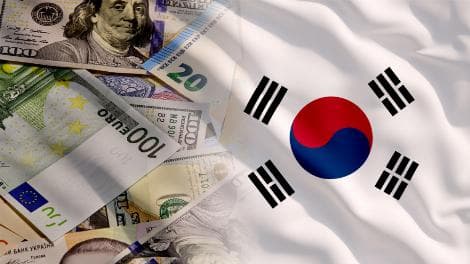
South Korea's official foreign reserves fell slightly to $427.0 billion at the end of May, down by $900 million from $427.9 billion in April, according to data released by the Bank of Korea on Thursday.
The decline was driven by a drop in securities holdings, which fell $3.4 billion to $380.7 billion. Securities remain the largest component of the reserve portfolio at 89.2% of the total, covering government bonds, agency bonds, debentures, mortgage-backed securities, and asset-backed securities.
Deposits partially offset the decline, rising $2.6 billion to $21.4 billion. Special Drawing Rights held steady at $15.8 billion, while gold and the country's IMF reserve position were little changed at $4.8 billion and $4.4 billion, respectively.
South Korea ranked 12th among countries by reserve holdings as of the end of April 2026, the BoK said, citing data from the IMF and relevant central banks. China led with $3.411 trillion, followed by Japan at $1.383 trillion and Switzerland at $1.082 trillion.
The reserve data comes as South Korea recently reported a record-high trade surplus in May on the back of a semiconductor boom.
Trade surplus reached nearly $27 billion during the month, topping market expectations of $24.3 billion and exceeding April's $23.8 billion.
Exports increased 53.2% to $87.8 billion, topping the $80 billion mark for the third straight month, and marking the sharpest pace of expansion since January 1984. It also beat the consensus 48.4% growth forecast of Investing.com.
The Bank of Korea recently held its policy rate unchanged at 2.5%. However, BoK Governor Shin Hyun-song signaled tighter policy in the near term.
"There is a need to raise interest rates at an appropriate time in the future."
ING economist Min Joo Kang said in a note last week that "[h]igher GDP and CPI forecasts for 2026 and 2027 reinforce our view that BoK hikes could persist into 2027." ING expects the BoK to tighten its policy in July.