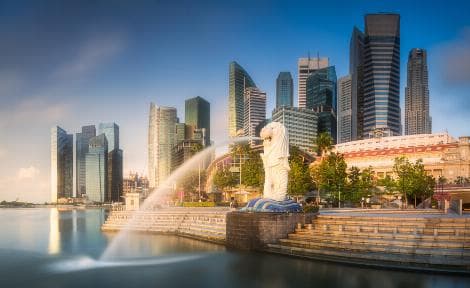
Singapore outlined plans to become an "AI-empowered economy" as part of an eight-point blueprint, aiming to position the city-state as a hub for developing and deploying artificial intelligence products at scale.
The Economic Strategy Review (ESR), submitted to the government by five private-sector-led committees and published Wednesday, calls AI "a force multiplier for Singapore's economy," capable of "unlocking growth, creating good jobs, and delivering tangible benefits for all Singaporeans."
"AI technology is advancing at an unprecedented rate. ... We need to be agile and continually review and update our strategies as AI capabilities evolve, to ensure that our businesses and workers keep pace with the technological changes," the report said.
The review, which launched in August 2025 under Singapore's Economic Resilience Taskforce, identified AI as its second of eight thrusts, positioning Singapore not as "the biggest frontier AI model or host the largest AI data centers," but as a "trusted hub where AI solutions are developed, tested, and deployed to tackle real-world problems at scale."
To achieve that goal, the government launched the National AI Council earlier this year, chaired by Prime Minister Lawrence Wong. The council is tasked with co-developing sector-specific problem statements and marshalling key resources such as datasets and data infrastructure, compute and regulatory sandboxes.
The council is focused on four areas: advanced manufacturing, finance, healthcare and logistics.
"We should also update our rules for AI governance and invest in AI safety capabilities, so that Singapore becomes a trusted environment for responsible AI innovation," according to the review.
The review also pushes for a "Champions of AI" program, an initiative announced in March, to integrate AI end-to-end across companies' operations.
Additionally, the ESR highlighted the need to adopt AI beyond leading firms to the wider business base. The review cited challenges among SMEs, such as capability and cost constraints, and lack of access to large, high-quality datasets to develop their AI services.
The AI plans are part of a broader set of economic recommendations in the ESR. Other recommendations include deepening capabilities for high-value manufacturing and modern services, expanding access to growth capital, and "diversifying risks, building buffers and deepening partnerships" for economic resilience.
The Ministry of Trade and Industry has projected GDP trend growth of 2% to 3% annually over the next decade. The ESR called the range "ambitious" based on the standards of advanced economies. The review said the target will not be easy to achieve amid "this challenging environment."