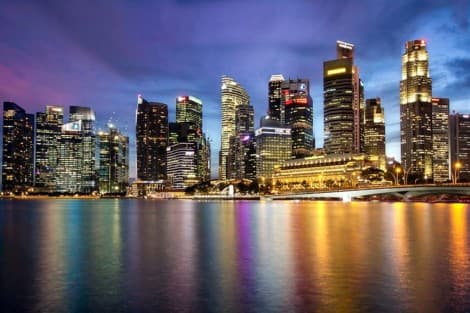
Singapore's merchandise trade surplus widened to its highest level since April 2025 in June, while non-oil domestic export growth moderated amid continued strength in AI-driven electronics demand.
The merchandise trade surplus widened to SG$13.8 billion in June from SG$5.57 billion in May, according to data released by Statistics Singapore and Enterprise Singapore on Friday.
The latest surplus exceeded the SG$6 billion surplus expected by Trading Economics.
Total merchandise exports rose to nearly SG$86 billion from SG$83.2 billion in May and SG$59.1 billion a year earlier.
Merchandise imports fell to SG$72.2 billion from SG$77.6 billion in May, although they remained above SG$49.5 billion in June 2025.
Separately, Singapore's non-oil domestic exports (NODX) increased 20.7% year over year in June, easing from 38.4% growth in May and falling short of the 30.2% increase expected by economists polled by Trading Economics.
NODX expanded 18.6% in the first half of 2026, with electronics exports remaining the key driver.
Enterprise Singapore attributed the growth to robust demand for integrated circuits, disk media products, and personal computers, supported by continued investment in artificial intelligence.
The latest trade and export figures reinforce expectations that Singapore's economy could exceed the government's 2% to 4% growth forecast for 2026, with resilient demand for AI-related electronics continuing to support the manufacturing sector despite a more uncertain global environment.
Advance estimates released by the Ministry of Trade and Industry on Tuesday showed the economy expanded 5.7% year over year in the second quarter, slowing from 6.3% in the previous three months but exceeding the 5.5% median forecast.
Manufacturing was the only sector to accelerate, driven by electronics and precision engineering on sustained AI-related demand, while growth in construction and services moderated.
Even so, policymakers have cautioned that external risks could weigh more heavily on the economy in the months ahead.
Earlier in June, Prime Minister Lawrence Wong said the impact of the conflict in the Middle East had yet to be fully reflected in Singapore's economy.
"There's a lag," Wong said at a Singapore Press Club event. "There are downside risks and we do expect more pressures to come on both growth and inflation in the second half of the year."
Wong noted that higher global oil prices had not yet fully filtered through to electricity, food, and fertilizer costs.
He added that the global economy had so far remained more resilient than anticipated, helped by countries securing alternative energy supplies and drawing down inventories after the closure of the Strait of Hormuz.