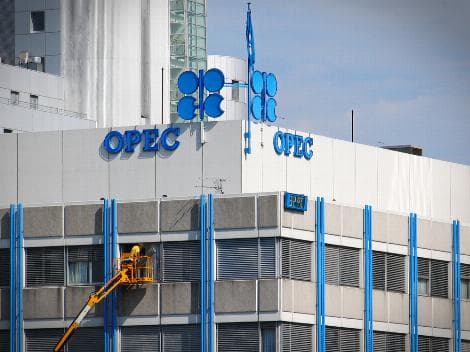
The Organization of the Petroleum Exporting Countries cut its global oil demand outlook for 2026 on Thursday as high energy prices are expected to weigh on consumption.
The cartel now expects oil consumption to increase by 380,000 barrels this year, down from its prior forecast that called for a gain of 580,000 barrels.
US crude oil prices surged past $100 per barrel on Thursday, a day after global benchmark Brent breached the same threshold amid intensifying tensions between the US and Iran. The renewed flare-up has sparked fears of prolonged supply disruptions.
Both West Texas Intermediate and Brent are up about 16% each so far this month, having logged gains in July and August.
The average diesel price in the US hit a fresh record high at $5.9773 per gallon on Thursday, according to AAA motor club data. The regular gas price rose to $4.2770 per gallon from $$4.0091 a month ago.
For 2027, OPEC now projects world oil demand to rise by 2.36 million barrels a day, compared with an increase of 2.16 million barrels estimated in August.
OPEC reiterated its outlook for an increase in liquids production from countries not participating in the Declaration of Cooperation, or DoC, by 640,000 barrels a day this year. The DoC is the name for OPEC+, which comprises OPEC and non-OPEC allies. Liquids production includes crude oil, condensate and natural gas liquids.
Last week, seven members of OPEC+ agreed to maintain output targets for October at the same level as September. The group previously decided to implement a production adjustment of 188,000 barrels a day this month.
The cartel continues to anticipate the world economy to expand at rates of 3% and 3.2% in 2026 and 2027, respectively. Growth projections for the US were left unchanged at 2.2% and 2% for the current and following years.
"Economic growth data from (the first half of 2026) confirmed robust growth momentum in the world economy," the organization said. "This is despite a challenging external environment marked by the economic repercussions of geopolitical tensions, renewed inflationary challenges, and uncertainty surrounding US tariffs, among other factors."
Major economies have entered the second half with "encouraging momentum," according to OPEC. The global resilience is expected to sustain through the end of 2026, driven by an artificial intelligence boom and consumer spending across major economies, the cartel added.