FINWIRES · TerminalLIVE
FINWIRES

Nasdaq, S&P 500 Hit Fresh Highs as Tech Stocks Rise

By
Nasdaq, S&P 500 Hit Fresh Highs as Tech Stocks Rise

The Nasdaq Composite and the S&P 500 reached fresh peaks on Wednesday, buoyed by a rally in technology stocks ahead of high-stakes talks between US President Donald Trump and his Chinese counterpart, Xi Jinping.

The Nasdaq rose 1.2% to 26,402.3 and the S&P 500 climbed 0.6% to 7,444.3. The Dow Jones Industrial Average slipped 0.1% to 49,693.2. Most sectors ended in the green, led by communication services, followed by tech, while utilities saw the steepest decline.

Chipmaking giant Nvidia's (NVDA) shares jumped 2.3%, among the best performers on the Dow. Apple (AAPL), Amazon.com (AMZN), and Cisco Systems (CSCO) also advanced. On Semiconductor (ON) shares surged 11%, the second-biggest gainer on the S&P 500.

Trump arrived in Beijing Wednesday, accompanied by Nvidia Chief Executive Jensen Huang, Apple's Tim Cook, and Tesla (TSLA) CEO Elon Musk, along with other executives. Trump is set to have talks with Xi on Thursday and Friday, CNBC reported.

"The trip underscores the stakes for chips, tech, and the (artificial intelligence) supply chain highlighted by Nvidia's most advanced chips, which (have) faced a series of tightening US export restrictions on China sales," Wedbush Securities said in note.

"We believe that this summit will prove 'constructive' as it keeps the conversation focused on reopening channels where possible rather than allowing the relationship to drift into a more permanent Cold War dynamic that would ultimately slow AI diffusion and cloud monetization on both sides," Wedbush said.

US Treasury yields were little changed in Wednesday late-afternoon trade, with the 10-year and two-year rates at 4.48% and 3.99%, respectively.

In economic news, US producer prices in April rose at the fastest pace in four years as broad-based increases in services and goods signaled intensifying inflation pressures, official data showed.

"On the heels of yesterday's disappointing (consumer price index) results, the April producer price report flags intense inflation pressure in the pipeline," BMO Capital Markets said in a note. "Look for another heated consumer inflation report in May, and not solely due to costlier gasoline, as price pressures stemming from the Iran war are bleeding into other sectors of the economy."

The central bank last month held rates steady for a third straight meeting and is widely expected to do so again in June, according to the CME FedWatch tool.

The US Senate confirmed Kevin Warsh's nomination as Fed chair on Wednesday. Warsh is Trump's pick for the job as the term of current central bank chief Jerome Powell is set to expire on Friday.

Boston Fed President Susan Collins expects the central bank to maintain its current monetary policy stance, which she described as "slightly restrictive."

"More than five years of above-target inflation has reduced my patience for 'looking through' another supply shock," Collins said in prepared remarks on Wednesday. "And while it is not

in my most likely outlook, I could envision a scenario in which some policy tightening is needed to ensure that inflation returns durably to 2% in a timely manner."

West Texas Intermediate crude was last down 0.9% at $101.27 a barrel, while Brent fell 1.8% to $105.85.

The International Energy Agency forecast a sharper decline in global oil demand this year than previously expected as the Middle East conflict drives up energy prices.

"More than 10 weeks after the war in the Middle East began, mounting supply losses from the Strait of Hormuz are depleting global oil inventories at a record pace," according to the report.

Separately, the Organization of the Petroleum Exporting Countries reduced its global oil demand growth outlook for 2026, but upgraded its projection for next year.

Trump recently rejected Iran's counteroffer to end the war, though a fragile ceasefire between the two countries still holds.

In company news, Wix.com (WIX) logged a larger-than-expected annual decline in its first-quarter earnings, while the Israeli web development platform maintained its full-year outlook. The company's US-listed shares tanked 27%.

Gold was last up 0.2% at $4,694.70 per troy ounce, while silver climbed 3% to $88.18 per ounce.
Related Articles

Japan March Current Account Surplus Widens 29% in March on Strong Overseas Investment
US Markets

Japan March Current Account Surplus Widens 29% in March on Strong Overseas Investment

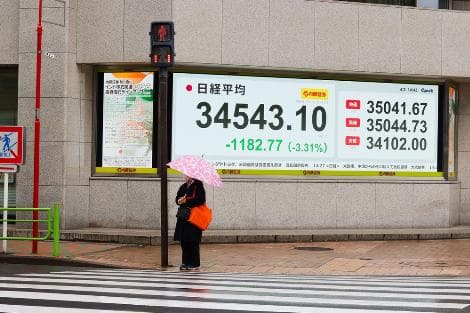
Japan posted a current account surplus of 4.682 trillion yen in March, up 29% from 3.625 trillion yen a year earlier, as strong overseas investment income continued to offset a deficit in services trade, data from Japan's Ministry of Finance and the Bank of Japan showed on Wednesday.The goods and services balance recorded a surplus of 572.80 billion yen in March, up 0.2% from a surplus of 571.60 billion yen a year earlier. The goods account posted a 35.9% increase in surplus to 830.50 billion yen as exports rose 11.7% to 10.822 trillion yen from 9.691 trillion yen a year earlier, while imports increased 10% to 9.992 trillion yen from 9.079 trillion yen.The services balance remained in deficit at 257.80 billion yen, wider by 548% from the 39.80 billion yen deficit recorded a year earlier. Primary income, which reflects returns on overseas investments, rose to a surplus of 4.631 trillion yen in March from 3.833 trillion yen a year earlier. The increase was driven mainly by direct investment income and portfolio investment income.Secondary income posted a deficit of 522.00 billion yen, narrower than the 778.90 billion yen deficit recorded a year earlier. The capital account showed a deficit of 69.60 billion yen in March. The financial account recorded a balance of 4.308 trillion yen, while net errors and omissions stood at negative 304 billion yen.The data comes as private-sector members of Japan's key economic advisory panel urged the Bank of Japan to proceed cautiously with monetary policy normalization, warning that prolonged geopolitical tensions in the Middle East could strain funding conditions for smaller firms.The proposals, submitted to the Council on Economic and Fiscal Policy, called for close monitoring of inflation expectations and liquidity conditions even as the central bank signals the possibility of near-term rate hikes.The members noted that while no clear signs of funding stress have emerged among small and mid-sized firms, higher energy costs and supply disruptions could increase financing needs. Bank of Japan data showed commitment line contracts rose by 2.5 trillion yen in March, the largest monthly increase since the pandemic period, underscoring precautionary cash buildup among companies.The panel also stressed closer coordination between fiscal and monetary authorities and urged broader measures of fiscal assessment beyond the primary balance as Japan navigates inflation pressures, currency weakness and external risks.

Nikkei 225
Nasdaq, S&P 500 Retreat From Record Highs Amid Losses in Tech Sector
US Markets

Nasdaq, S&P 500 Retreat From Record Highs Amid Losses in Tech Sector

The Nasdaq Composite and the S&P 500 fell Tuesday as technology shares slid, with traders apparently spooked by a hotter-than-anticipated inflation report and higher oil prices.The Nasdaq shed 0.7% to 26,088.2, while the S&P 500 lost 0.2% to 7,401, following their back-to-back record closing highs. The Dow Jones Industrial Average added 0.1% to 49,760.6, rising for a third consecutive session. Most sectors ended in the green, led by healthcare, while consumer discretionary saw the steepest decline.Shares of several big tech names tumbled with Qualcomm (QCOM) sliding nearly 12%, the worst performer on the S&P 500. Intel (INTC) followed Qualcomm on the index, down 6.8%. Salesforce (CRM) dropped 3.5%, the steepest decline on the Dow, followed by IBM (IBM), which fell 1.9%.Micron Technology (MU), Oracle (ORCL), Advanced Micro Devices (AMD), Dell Technologies (DELL), Microsoft (MSFT) and Amazon.com (AMZN) also logged declines.In economic news, US annual consumer inflation accelerated in April to the fastest pace in almost three years as energy prices surged amid the near-complete closure of the Strait of Hormuz. Core inflation, which excludes the volatile food and energy components, hit a seven-month high, official data showed."The unfavorable and larger-than-expected jump in core prices shows pressures are now spreading beyond energy, transportation, and food, into larger categories such as services and housing," Scott Anderson, chief US economist at BMO, said in a report. "If the energy price shock doesn't subside soon, we can expect more of the same in the months ahead."Energy prices surged nearly 18% annually last month, marking the biggest jump since September 2022, official data showed."The closure of the Strait of Hormuz is doing significant damage to the (Federal Reserve's) ability to hold the line on inflation," Anderson said. "At a minimum, this inflation report will keep the Fed on hold longer and may facilitate a move toward a more neutral policy stance at upcoming meetings -- removing the (Federal Open Market Committee's) implicit rate cut bias."The Fed, which late last month kept its policy rate steady for a third consecutive meeting, is widely expected to stay put again next month, according to the CME FedWatch tool. Its latest policy statement include an easing bias, which was opposed by three regional presidents.Chicago Fed President Austan Goolsbee said inflation data on the services side was "unexpectedly disappointing," Reuters reported.Inflation is "going the wrong way, and it's going the wrong way not just in oil-related things and not just in tariff-related things," Goolsbee was quoted as saying at an event in Rockford, Illinois.US Treasury yields were higher, with the 10-year rate up five basis points at 4.46% and the two-year rate rising 3.2 basis points to 4%.West Texas Intermediate crude was last up 4.4% at $102.39 per barrel, while Brent rose 3.5% to $107.86.US President Donald Trump recently rejected Iran's counteroffer to end the war, extending uncertainty around oil flows through the crucial Strait of Hormuz.Trump is now more seriously considering restarting military operations against Iran than he has in recent weeks, CNN reported, citing his aides. Trump, who will fly to Beijing this week, reportedly said he will have a "long talk" about the Iran war with Chinese leader Xi Jinping, though he downplayed the idea he would want China to play a role in ending the conflict."The global oil market continued to tighten amid limited prospects for a reopening of the Strait of Hormuz," Saxo Bank said in a report.In company news, EBay (EBAY) rejected video game retailer GameStop's (GME) proposal to acquire the e-commerce company in what would have been a $55.5 billion deal. EBAY shares rose 2.1%, while GameStop fell 3.5%.Gold was last down 0.2% at $4,721.20 per troy ounce, while silver gained 1.6% to $87.30 per ounce.

Dow JonesNasdaq CompositeS&P 500$AMD$AMZN$CRM$DELL$EBAY$GME$IBM$INTC$MSFT$MU$ORCL$QCOM
Target Likely to Post Strong First-Quarter Comparable Sales Growth, UBS Says
US Markets

Target Likely to Post Strong First-Quarter Comparable Sales Growth, UBS Says

Target (TGT) is expected to post strong fiscal first-quarter comparable sales growth, indicating a "cleaner" setup into the year for the retailer, UBS Securities said in a note e-mailed Tuesday.The market is anticipating Target's first-quarter comparable sales growth of 4% to 5%, ahead of the company's projections and the consensus view for an increase of about 1%, according to the brokerage. The company's comparable sales in the quarter grew 3.9%, UBS said in a note to clients, citing Bloomberg Second Measure data."Despite a tumultuous last few years, (Target's) recovery in 2026 is off to a promising start," UBS analysts, including Michael Lasser, said. "Many of last year's headwinds are now rolling off, including the impact from boycotts, one-time tariff costs, and elevated markdown activity.""As a result, the setup into 2026 is cleaner," the analysts wrote.Target is scheduled to report results May 20.The company is also reaping gains from its transformation initiatives that include streamlining operations and improving merchandising relevance, according to UBS.Based on recent traffic trends, Target may be outperforming both Walmart (WMT) and Costco Wholesale (COST) on a year-over-year basis, though against "much easier" comparisons, the analysts said."In essence, we think the company will report $0.30 to $0.40 of (earnings-per-share) upside in (the first quarter)," the analysts wrote. Target is expected to pass this through to its full-year bottom-line outlook, bringing the updated range to $7.85 to $8.85 from $7.50 to $8.50, according to the note.While the company's turnaround plan seemed to have impressed investors, as its shares have advanced more that 20% so far this year, UBS still sees "significant more potential" for the stock.The brokerage outlined what it called "three elements of the upside case.""First, there is potential for comp outperformance that is not fully reflected in expectations," the analysts said. "Second, if that outperformance materializes, it should translate into better flow-through on margins. And third, we think there's room for the multiple to run higher."Price: $121.50, Change: $+3.06, Percent Change: +2.58%

$COST$TGT$WMT