FINWIRES · TerminalLIVE
FINWIRES

Marriott Misses Street Views on Second-Quarter Revenue Amid Middle East Conflict

By
Marriott Misses Street Views on Second-Quarter Revenue Amid Middle East Conflict

Marriott International (MAR) reported second-quarter revenue below Wall Street's estimates on Monday amid headwinds related to the Middle East conflict, while the hotel giant provided a downbeat earnings outlook for the ongoing three-month period.

The company's revenue came in at $7.07 billion for the quarter ended June, up from $6.74 billion a year earlier, but below the FactSet-polled consensus of $7.19 billion. Adjusted earnings rose to $3.19 per share from $2.65, topping the Street's view for $3.08.

The stock fell 6.4% in Monday trade, reducing its year-to-date gain to 12%.

Global revenue per available room, or RevPAR, increased 3.4% in the quarter, amid "continued (average daily rate) strength," Chief Executive Anthony Capuano said in a statement. RevPAR in the US and Canada rose 5%, buoyed by broad-based increases across hotel tiers and customer segments, Capuano said.

In international markets, the metric slumped 0.5% as a 43% plunge in the Middle East due to the Iran war offset "solid" growth across other regions, Capuano said. The Middle East was still a "bit better than prior expectations on better-than-expected domestic demand," Capuano said during an earnings call, according to a FactSet transcript.

The US and Iran resumed hostilities last month, just weeks after signing a memorandum of understanding to end the conflict that began at the end of February.

In a client note emailed Monday, Truist Securities estimated Marriott's exposure to the Middle East at roughly 4%, the highest of the US-based hotel C corporations. Last week, rival Hilton Worldwide (HLT) reported better-than-expected quarterly results, with its system-wide comparable RevPAR gaining 3.9%. RevPAR in the Middle East dropped around 36%.

For the current quarter, Marriott anticipates adjusted EPS to be in a range of $2.74 to $2.82, while the Street is looking for $2.86. Worldwide RevPAR is projected to grow 3.5% to 4%.

Revenue in the third quarter is expected to be helped by the FIFA World Cup, although the US-Iran war is likely to continue to have an impact on the Europe, Middle East and Africa region, Chief Financial Officer Jen Mason said on the call. "In the fourth quarter, the Middle East faces difficult comparisons from the fourth quarter of 2025, where several large events drove meaningful ADR increases," according to Mason.

For the 2026 full year, the company now expects adjusted EPS to come in between $11.64 and $11.81, up from its previous guidance of $11.38 to $11.63. The Street is looking for non-GAAP EPS of $11.62. Global RevPAR is pegged to grow by 3% to 3.5%, compared with the prior outlook for a 2% to 3% increase.

Price: $352.00, Change: $-20.84, Percent Change: -5.59%
Related Articles

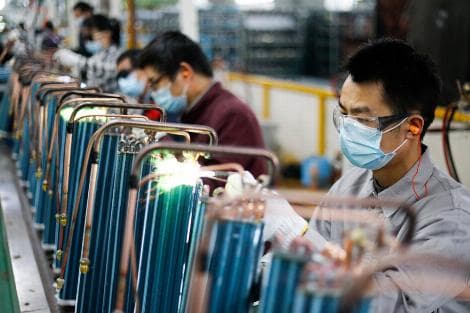
China's Factory Activity Eases to Four-Month Low in July
US Markets

China's Factory Activity Eases to Four-Month Low in July

China's manufacturing sector growth moderated to a four-month low in July, though output and new orders remained firmly in expansionary territory, according to the RatingDog China General Manufacturing PMI released on Monday.The headline seasonally adjusted Purchasing Managers' Index (PMI) slipped to 50.9 from 51.7 in June. Despite the slowdown, the sector extended its current growth streak to match the joint-longest sequence in five years, matching the sequence from November 2023 to June 2024.Growth was supported by stronger overall demand, higher international sales, new business channels, and improved product quality, which pushed new orders higher for the fourteenth consecutive month.The expansion in new work and workloads prompted manufacturers to increase headcounts for the second straight month.However, producers trimmed their input purchasing for the first time since November 2025, pointing to an ongoing accumulation of previously ordered stock.Input cost pressures moderated, allowing output prices to remain broadly unchanged. Bolstered by strong demand, enhanced efficiency, and upcoming product launches, business sentiment remained optimistic regarding output levels over the coming year."Sustained new order growth and further easing of cost pressures provided support, while the return of new export orders to expansion was a positive signal," Yao Yu said. "However, the reduction in purchasing activity and ongoing accumulation of input stocks warrant attention."

Shanghai Composite^SZSE
Japan's Manufacturing Expansion Eases in July Despite Strong AI-Led Demand
US Markets

Japan's Manufacturing Expansion Eases in July Despite Strong AI-Led Demand

Japan's manufacturing sector continued to expand, albeit at a softer pace in July, with strong demand for semiconductors and artificial intelligence-related products driving the fastest growth in new orders, according to final data from S&P Global released on Monday.The final S&P Global Japan Manufacturing Purchasing Managers' Index (PMI) came in at 54.5 in July, missing the flash estimate of 54.7 and compared with the 54.8 recorded in the previous month.The reading remained well above the 50-point threshold that separates expansion from contraction, marking the seventh consecutive month of improving business conditions.Manufacturing output rose at its fastest pace since February 2014 as companies responded to stronger demand.Total new orders increased at the quickest rate since January 2022, while export orders posted their strongest growth in just over five years, driven by demand from Asia and the United States."Companies often commented that the improvement coincided with greater global demand across the key semiconductors industry, while some firms commented on growth in AI-related areas of manufacturing," Annabel Fiddes, economics associate director at S&P Global Market Intelligence, said.Manufacturers also increased hiring and purchasing activity, although backlogs of work grew at the fastest pace since February 2014, pointing to mounting capacity pressures.Firms continued to report supply-chain disruptions linked to the conflict in the Middle East, prompting stock-building and longer supplier lead times.Input cost inflation remained sharp, reflecting higher oil and raw material prices, although the pace eased to its slowest since March. Selling prices also rose substantially during the month.Business confidence improved to a four-month high, with manufacturers expecting stronger demand over the coming year, particularly from the semiconductor industry.

Nikkei 225
China's EV Manufacturers Report Strong July Sales, Led by Leapmotor's 102% Surge
US Markets

China's EV Manufacturers Report Strong July Sales, Led by Leapmotor's 102% Surge

Most Chinese electric-vehicle manufacturers reported higher deliveries in July versus a year earlier, led by Zhejiang Leapmotor Technology (HKG:9863), which saw its sales double from a year earlier.Stellantis-backed Leapmotor delivered 101,267 vehicles globally in July, up 102% year over year, exceeding the 100,000-unit mark in a single month for the first time.Deliveries in the first seven months of the year totaled 457,754 units, up 68.4% and achieving about 46% of its full-year target of 1 million.BYD (HKG:1211, SHE:002594) sold 419,211 new energy vehicles in July, up 21.8% from 344,296 a year earlier, according to a Hong Kong bourse filing on Sunday. The company exported 180,538 NEV units during the month.XPeng (HKG:9868) delivered 38,027 vehicles globally in July, up 4% year over year, the company said in a press release on Saturday. Cumulative deliveries surpassed 1.2 million units as of July 31.Li Auto (HKG:2015) sold 30,468 vehicles in July, with cumulative deliveries reaching 1.8 million as of July 31, the company said in a bourse filing on Sunday. While the company did not mention year-over-year growth, data from July 2025 shows that latest deliveries rose 0.86% from the 30,731 vehicles sold last year.NIO (HKG:9866, SGX:NIO) delivered 35,934 vehicles in July, up 71% from a year earlier. The sales consisted of 20,008 vehicles from its namesake NIO brand, 10,155 vehicles from its ONVO brand, and 5,771 units from its FIREFLY brand. Cumulative deliveries reached 1.2 million units.Geely Automobile (HKG:0175) sold 250,161 vehicles in July, up 5% from a year earlier. Exports surged 202% to 106,663 units from 35,272 units.The company's Zeekr brand saw sales jump 111% to 35,837 units from 16,977 units last year. Lynk & Co deliveries, however, plunged 40% to 16,382 units.However, overall NEV sales at home are expected to have fallen to 980,000 units in July from the previous month amid a seasonal slowdown, CnEVPost reported, citing data from the China Passenger Car Association.July is a traditionally slow season for auto sales in China as high temperatures and heavy rain and flooding in some regions affect showroom traffic and deliveries, according to CnEVPost.

HKG:0175HKG:1211HKG:2015HKG:9863HKG:9866HKG:9868SGX:NIOSHE:002594