FINWIRES · TerminalLIVE
FINWIRES

Manufacturing Sector Expansion Hits 4-Year High, ISM, S&P Surveys Show

By
Manufacturing Sector Expansion Hits 4-Year High, ISM, S&P Surveys Show

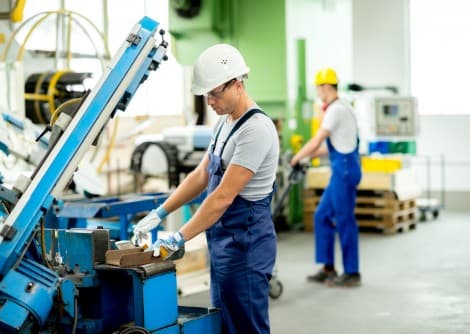
The US manufacturing sector expanded to its highest level in four years last month amid strength in demand and production, though price pressures remained elevated, two separate surveys showed Monday.

The Institute for Supply Management's purchasing managers' index increased to 54 in May from 52.7 the month prior, reaching its highest reading since May 2022. The consensus was for a 53 reading in a survey compiled by Bloomberg. A reading above 50 indicates the manufacturing sector is generally expanding.

The ISM survey indicates "a meaningful improvement in underlying manufacturing momentum, with the broad-based pickup in new orders, production and trade flows signaling firmer demand conditions both domestically and externally," TD Economics Senior Economist Vikram Rai said in a note. "The rise in the headline PMI to a multiyear high, alongside gains in backlogs and inventories and a smaller share of activity in contraction, suggests that the sector is transitioning from a fragile recovery to a more durable expansion phase."

The new orders index rose to 56.8 from 54.1 sequentially in May, while production improved to 54.3 from 53.4. The employment measure increased to 48.6 from 46.4, but remained in contraction for the 32nd straight month. The prices gauge fell to 82.1 from 84.6, indicating raw materials prices rose for a 20th consecutive month, the ISM survey showed.

"Even with improving activity, the persistence of elevated cost pressures is likely to constrain the pace of expansion and keep policymakers cautious, limiting the scope for near-term monetary-policy easing," Rai said.

Markets widely expect the Federal Reserve to keep its benchmark lending rate unchanged later this month, which would mark its fourth straight pause, according to the CME FedWatch tool.

Separately, S&P Global (SPGI) said Monday its manufacturing PMI advanced to 55.1 last month from 54.5 in April, also representing the highest print since May 2022. New orders "increased markedly," while output and sales were partly driven by stock building as firms looked to mitigate supply chain disruptions and elevated prices amid the ongoing Middle East conflict, the data provider said.

"The headline PMI has hit a four-year high, with strong factory production growth for a second successive month in response to a further marked upturn in order books," S&P Global Market Intelligence Chief Business Economist Chris Williamson said. "But since the outbreak of war in the Middle East, we have seen production and demand buoyed by stock building as companies worry over rising prices and supply difficulties."

Input costs increased at a rate "unmatched" in almost four years, while supplier delivery times deteriorated to "the greatest extent" since August 2022, S&P said.

"Stockpiling was again widely evident in May and makes it hard to take an accurate reading on the underlying health of the manufacturing economy," Williamson said. "The resulting steep jump in producer costs sends a worrying signal that broader economy inflation has further to rise in the coming months."

Price: $425.36, Change: $+1.36, Percent Change: +0.32%

Related Articles

Japan's Capital Spending Growth Grinds to a Halt in Q1
US Markets

Japan's Capital Spending Growth Grinds to a Halt in Q1

Japanese companies' capital spending was flat year over year in the first quarter, compared with the 6.5% growth in the previous quarter, according to government data released Monday.The result missed market expectations for a 4.1% increase, according to Investing.com.Capital spending fell 2% on a seasonally adjusted quarterly basis, the data showed.Meanwhile, manufacturers' spending declined 0.4% from a year earlier.Despite the weak investment figures, corporate sales rose 1.1% year over year, while ordinary profits increased 14.6%.The Iran war has rattled the global economic outlook, with oil prices surging after Tehran effectively closed the Strait of Hormuz, leaving energy-import-dependent Japan particularly vulnerable to the resulting supply shock."Capital spending came in significantly weaker than expected. While it's too early to say for certain, we may be starting to see some impact from the Middle East conflict," Yuichi Kodama, chief economist at Meiji Yasuda Research Institute, was quoted as saying by Bloomberg News."It's also possible that some companies decided at the last minute to hold back planned investment," Kodama added.The Ministry of Finance survey is closely watched as an indicator of corporate investment trends and broader economic activity in Japan.The figures will be used in revised gross domestic product data for the January-March quarter due on June 8.Preliminary data showed Japan's economy expanded at an annualized real rate of 2.1%, marking a second consecutive quarter of growth.The data leaves room for debate as the Bank of Japan's outlook weighs further interest rate increases.Recent hawkish remarks from BOJ policymakers have prompted investors to price in roughly a 79% chance of a rate increase at the June 15-16 meeting."Results were weaker than expected, reflecting a pullback from earlier strength," Kazutaka Maeda, an economist at Meiji Yasuda Research Institute, was quoted as saying by Reuters."But given steady demand for labor-saving investments and similar areas, capital expenditures are unlikely to deteriorate sharply from here," he added, noting that the outlook would depend on developments in the Middle East.

Nikkei 225
China's Factory Activity Stalls in May; Services Activity Rebounds
US Markets

China's Factory Activity Stalls in May; Services Activity Rebounds

China's manufacturing sector slowed down in May, while the services sector staged a recovery, helping overall private-sector activity rise last month, according to official data released Sunday by the National Bureau of Statistics.The official purchasing managers' index fell to a neutral 50 from 50.3 in April, marking the lowest in three months. It also came in lower than the 50.2 consensus estimate from Investing.com.A reading above 50 means growth, while a reading below 50 indicates contraction.The production sub-index came in at 51.2, down from 51.5 in April, indicating that manufacturing output continued to expand, albeit at a softer pace. However, demand showed signs of softening, with the new orders index falling to 49.9 from 50.6 in April, suggesting a slight decline in demand within the manufacturing sector.The data also pointed to a divergence between large and smaller firms, with the PMI for large enterprises rising to 51.1 from 50.2, while the PMIs for medium and small enterprises both fell to contraction territory at 48.6 and 48.5 from 50.5 and 50.1, respectively, in April.Input costs remained elevated in May, despite easing slightly, with the raw materials purchase price index falling to 60.5 from 63.7 the previous month. The factory price index also softened to 51.9 in May from 55.1 previously.Meanwhile, services activity in China recovered in May, with the official non-purchasing managers' index rising to 50.1 from 49.4 in April.The latest reading in the index, which measures activity in the services and construction sectors, is higher than the 49.5 consensus estimate on Investing.com.Activity within the construction sector contracted for the fifth straight month in May, with the sub-index rising to 48.8 from 48 in April. Elsewhere, railway transportation, telecommunications and broadcasting, and insurance all posted PMIs above 55, while air transportation and real estate remained below the critical threshold.New orders in the non-manufacturing sector continued to contract in May, but at a softer rate compared with April.China's composite PMI output index, which combines manufacturing and non-manufacturing activity, rose to 50.5 in May from 50.1 in April.

Shanghai Composite^SZSE
Australian Manufacturing Sector's Growth Decelerates in May as Middle East Conflict Continues to Reverberate
US Markets

Australian Manufacturing Sector's Growth Decelerates in May as Middle East Conflict Continues to Reverberate

Australia's manufacturing sector expanded in May, but the pace of growth slowed from the previous month amid intense supply-chain disruption and as new orders recorded their sharpest decline since October.The seasonally adjusted S&P Global Australia Manufacturing Purchasing Managers' Index came in at 50.7 for May, down from a 51.3 reading in the previous month but still higher than the 50 mark that separates growth from contraction.Lower sales, elevated prices, and uncertainty generated by the Middle East conflict all factored into a further decline in manufacturing production in May, as output declined for a fourth straight month, the index provider said Monday.The impact of the Iran war remains widespread, with higher fuel costs resulting in longer delivery times for suppliers amid delays in international freight transport. At the same time, output price inflation accelerated and was the steepest since August 2022."Familiar themes were evident in the Australian manufacturing PMI data during May, with the war in the Middle East continuing to cause steep price rises and supply-chain disruption," said Andrew Harker, economics director at S&P Global Market Intelligence. "As a result, firms are finding it increasingly difficult to secure new orders."On a positive note, business confidence ticked higher alongside a slight increase in employment as firms maneuvered to accelerate production lines. However, the rise in employment is "unlikely to be sustained" if new business continues to slide in the near future, Harker said.He added that Australia faces the prospect of posting a fall in production in the second quarter "unless we see a marked turnaround in fortunes during June."The Reserve Bank of Australia has raised borrowing costs three times so far this year. The central bank expects inflation to remain above its 2% to 3% target range for a prolonged period after a recent surge in fuel and related commodity prices.

ASX 200