FINWIRES · TerminalLIVE
FINWIRES

Lennar Guides Below-Consensus Earnings as Rising Interest Rates Worsen Affordability Squeeze

By
Lennar Guides Below-Consensus Earnings as Rising Interest Rates Worsen Affordability Squeeze

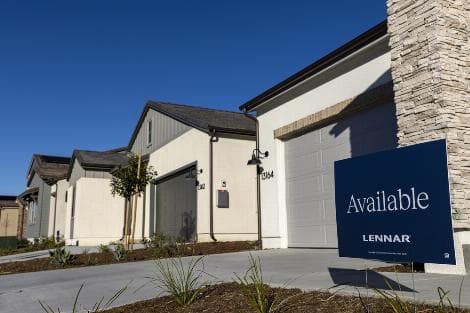
Lennar (LEN, LEN.B) on Thursday projected below-consensus earnings for the fiscal fourth quarter as the homebuilder's chief executive cautioned that rising interest rates could further pressure housing affordability.

The company expects earnings per share of $1.30 to $1.65 for the ongoing quarter, Chief Financial Officer Diane Bessette said during an earnings conference call. Analysts in a FactSet poll are looking for fourth-quarter EPS of $2.02 on a GAAP basis and $2 on a non-GAAP basis.

Lennar's fiscal third-quarter adjusted EPS of $1.23 trailed the $1.29 consensus view late Wednesday. Revenue declined to $8.05 billion from $8.81 billion a year earlier, below Wall Street's $8.32 billion expectation.

"Interest rates and consumer confidence constrained the improvement that we anticipated going into the quarter," Chief Executive Stuart Miller said on the call, according to a FactSet transcript.

The ongoing housing shortage continues to drive the need for more supply, but "the market becomes more difficult as interest rates test affordability, particularly within our price ranges," Miller told analysts.

Miller said that the 30-year fixed mortgage rate is now at approximately 7%, up from 6.4% to 6.5% during the last earnings call.

"So the modest relief we saw earlier in the year has reversed," he said. "To carry a home, fewer families can afford to both produce a down payment and qualify for a mortgage."

On Wednesday, the Federal Reserve's raised its policy rate for the first time in just over three years amid persistent inflation and signaled an additional hike later this year.

"The (Fed's) assistance is clearly off the table for practical purposes and not a near-term source of relief," Miller said.

The Fed will likely lift interest rates by additional 50 basis points by the end of the first quarter, Deutsche Bank and Macquarie Group said, pointing to what they saw as a hawkish "dot plot."

US housing starts declined to a three-month low in August, government data showed Thursday, as homebuilders grappled with higher financing and material costs. On Wednesday, the National Association of Home Builders and Wells Fargo said that homebuilder confidence reached a 12-month low in September.

"Rate cuts, when they eventually come, will be a meaningful tailwind for our business, but we are not holding our breath," Miller said. "We are not building our business plan around those rate cuts."

Lennar's class A stock was down 0.3% intraday, and has fallen 24% so far this year.

Price: $78.00, Change: $-0.36, Percent Change: -0.46%

What else is happening in US Markets?

New Zealand Economy Shows Resilience Amid Middle East Conflict
US Markets

New Zealand Economy Shows Resilience Amid Middle East Conflict

The New Zealand economy showed expansion in the June quarter despite the Middle East conflict and continued pressure on global oil prices.New Zealand's economy expanded 0.2% in the June quarter, following a 0.9% expansion in the previous quarter, with the GDP per capita rising 0.1%.Nine out of 16 industries recorded higher economic activity in the June quarter, with construction leading gross domestic product growth at 2.7% while transport, postal, and warehousing were the largest negative contributors, declining 1.7%.The expenditure measure of GDP rose 0.4% in the June quarter, following a 1.1% increase in the previous quarter, as export volumes rose 3.3% while import volumes fell 0.8%.Westpac, which also expected 0.2% quarterly growth, said the data was a little softer in the details than expected, as the non-additive balancing item and agriculture, transport and administrative services showed lower growth than anticipated.ANZ, which expected a 0.1% quarterly rise, said that data suggests that the economy has grown at a "reasonable pace" in the months following June, but recovery will likely be "patchy" due to ongoing offshore volatility.The financial services firm expects the Reserve Bank of New Zealand to hike interest rates by 25 basis points in October as it believes that global developments since the September meeting suggest that a sooner hike would be more prudent.

^NZ50
Update: Wall Street Extends Losses Following Fed Hike
US Markets

Update: Wall Street Extends Losses Following Fed Hike

(Updates with market moves at the end of the day, and other changes, if any.)US stocks fell for a third straight session on Wednesday after the Federal Reserve delivered its first interest rate increase since 2023 and signaled another hike later this year amid elevated inflation.The Dow Jones Industrial Average shed 1.2% to close at 51,461.90, while the S&P 500 dipped 0.5% to 7,551.81. The Nasdaq Composite settled just below the flatline at 25,978.42. Most sectors ended in the red, led by energy.In a unanimous vote, the central bank's Federal Open Market Committee lifted the federal funds rate to a range of 3.75% to 4%. The Fed's latest Summary of Economic Projections document showed the median policy rate at 4.1% at the end of 2026, up from 3.8% projected in June."Inflation remains elevated," the FOMC said in a statement. "Today's policy action will support a timelier return to the committee's 2% (inflation) goal."Policymakers raised their 2026 projections for personal consumption expenditure headline and core inflation, but left forecasts for 2027 unchanged."The plain fact is that inflation is too high and has been for too long," Fed Chair Kevin Warsh said in a press conference. "This summer's inflation readings do not tell me that underlying trends have meaningfully improved."The Fed now sounds "more hawkish" than it did in June, according to ING Bank."Our growth, inflation and jobs forecasts suggest little need for further rate hikes, and it may well be that the Fed is striking a hawkish line in order to build more credibility with bond markets as they look to support Treasury efforts to anchor the long end of the curve," ING said in a report.Treasury yields were higher following the Fed announcement, with the two-year rate up six basis points at 4.73% and the 10-year rate rising 1.4 basis points to 5.01%.In other economic news, US retail sales rebounded more than expected in August as higher fuel prices lifted spending at gasoline stations and outlays on motor vehicles turned positive.US homebuilder confidence this month hit its lowest level since September 2025 amid elevated mortgage rates and material costs, the National Association of Home Builders and Wells Fargo said.West Texas Intermediate crude oil was down 3.6% at $101.99 a barrel in Wednesday late-afternoon trade, while Brent dropped 3.1% to $105.39.Saudi Arabia is working to return about half the capacity of its East-West oil pipeline within days, Bloomberg News reported. Drone attacks led to the shutdown of that pipeline last week.Shares of Intel (INTC) rose 4% following a Reuters report that the chipmaker and SK Hynix (SKHY) were discussing a US memory chip partnership."SK Hynix is exploring various options to strengthen its global competitiveness, but no specific plans or arrangements have been finalized at this time," the company said in a statement. SK Hynix's US-listed shares were little changed.J.B. Hunt Transport Services (JBHT) tumbled 13%, the worst performer on the S&P 500, after Chief Financial Officer Brad Delco said during a conference call Tuesday that the company expects its third-quarter profit to decline sequentially.Spot gold edged down 0.5% to $4,271.55 per troy ounce, while silver lost 1.4% to $66.75 per ounce.

Dow JonesNasdaq CompositeS&P 500$INTC$JBHT$SKHY
Union Pacific Set to Benefit From Continued Volume Gains in 2027, UBS Says
US Markets

Union Pacific Set to Benefit From Continued Volume Gains in 2027, UBS Says

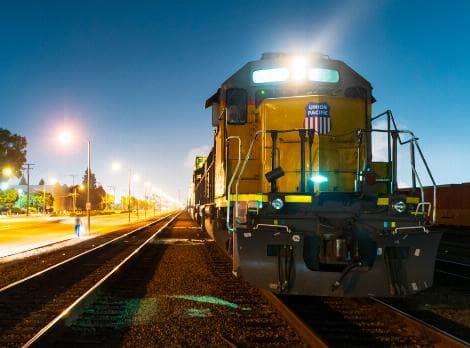
Union Pacific (UNP) is set to benefit from continued volume gains in 2027, along with pricing tailwinds, UBS Securities said Wednesday.The brokerage expects the railroad operator's total volume to grow 3.5% next year following an estimated 3.9% increase in 2026.The intermodal business volume is seen rising 6% to 7% in 2027, along with gains within the industrial segment, UBS analysts, including Thomas Wadewitz, said."Our analysis of key customer markets points to a second year of strong volume growth in 2027 and our analysis of intermodal and merchandise pricing versus the truckload market points to a stronger tailwind from price," Wadewitz wrote.The investment firm upgraded its rating on Union Pacific's stock to buy from neutral and raised the price target to $339 from $310.UBS increased its earnings per share estimates to $13.41 from $13.33 for 2026 and to $14.90 from $14.75 for 2027. Wall Street expects $13.06 and $14.15, respectively, according to the brokerage."The time lag of rail pricing to truck points to stronger pricing for (Union Pacific) and a price/mix (versus) inflation impact which is neutral rather than a headwind," Wadewitz said.A merger with Norfolk Southern (NSC) should drive upside for Union Pacific over the next 12 months, Wadewitz wrote. In 2025, Union Pacific agreed to acquire Norfolk in a cash-and-stock deal valuing the smaller railroad operator at about $85 billion.While the regulatory approval path remains unpredictable, a successful combination could result in pro-forma EPS in a range of $19.40 to $21.90 in 2030, UBS said.Union Pacific's shares closed 1.1% down on Wednesday, while Norfolk Southern's stock fell 1%.Norfolk Southern and Union Pacific reported stronger-than-expected second-quarter results in July amid robust freight demand and higher fuel surcharges.In July, US railroad operator CSX (CSX) posted a second-quarter beat on profit and revenue as volume increased, driven by intermodal growth.Price: $281.03, Change: $-2.96, Percent Change: -1.04%

$CSX$NSC$UNP