FINWIRES · TerminalLIVE
FINWIRES

Integer Agrees to Be Taken Private by KKR in $5.7 Billion Deal

By
Integer Agrees to Be Taken Private by KKR in $5.7 Billion Deal

Integer (ITGR) has agreed to be acquired and taken private by investment firm KKR (KKR) in an all-cash deal with an enterprise value of about $5.7 billion, the companies said in a joint statement on Monday.

Shareholders of Integer will receive $127 per share, a premium of roughly 52% to the medical device manufacturer's share price on April 29, the last trading day before it disclosed a strategic review.

Integer serves the cardio and vascular, neuromodulation and cardiac rhythm management markets.

Its stock gained 2.7% in most recent premarket activity, while KKR was up 2%.

The proposed transaction offers "immediate and certain value" to shareholders, Integer Chief Executive Payman Khales said in the statement.

The deal is expected to provide Integer with long-term capital to invest in capacity, technology and innovation, according to the companies.

"Integer is an exceptional platform with highly differentiated capabilities across a global manufacturing footprint," KKR Partner Max Lin said. "We are excited by the opportunity to deploy capital and resources to further advance Integer's next chapter of growth and innovation."

The transaction, which requires approval from Integer's shareholders and clearance from regulators, is expected to complete by the end of the year. Following completion, Integer's shares will no longer trade publicly.

Separately, Integer reported second-quarter adjusted earnings of $1.60 per share, up from $1.55 a year earlier, ahead of the FactSet-polled consensus of $1.38. Sales declined 2.6% to $464.1 million, but came in higher than the Street's view for $450.7 million.

The company withdrew its outlook in light of its proposed acquisition by KKR.
Related Articles

China's Factory Activity Eases to Four-Month Low in July
US Markets

China's Factory Activity Eases to Four-Month Low in July

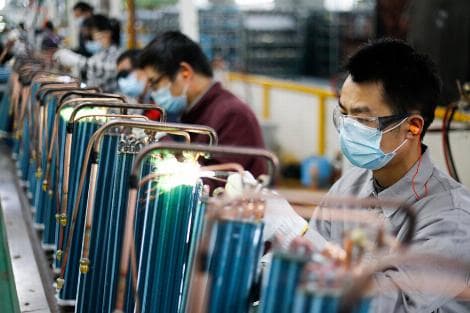
China's manufacturing sector growth moderated to a four-month low in July, though output and new orders remained firmly in expansionary territory, according to the RatingDog China General Manufacturing PMI released on Monday.The headline seasonally adjusted Purchasing Managers' Index (PMI) slipped to 50.9 from 51.7 in June. Despite the slowdown, the sector extended its current growth streak to match the joint-longest sequence in five years, matching the sequence from November 2023 to June 2024.Growth was supported by stronger overall demand, higher international sales, new business channels, and improved product quality, which pushed new orders higher for the fourteenth consecutive month.The expansion in new work and workloads prompted manufacturers to increase headcounts for the second straight month.However, producers trimmed their input purchasing for the first time since November 2025, pointing to an ongoing accumulation of previously ordered stock.Input cost pressures moderated, allowing output prices to remain broadly unchanged. Bolstered by strong demand, enhanced efficiency, and upcoming product launches, business sentiment remained optimistic regarding output levels over the coming year."Sustained new order growth and further easing of cost pressures provided support, while the return of new export orders to expansion was a positive signal," Yao Yu said. "However, the reduction in purchasing activity and ongoing accumulation of input stocks warrant attention."

Shanghai Composite^SZSE
Japan's Manufacturing Expansion Eases in July Despite Strong AI-Led Demand
US Markets

Japan's Manufacturing Expansion Eases in July Despite Strong AI-Led Demand

Japan's manufacturing sector continued to expand, albeit at a softer pace in July, with strong demand for semiconductors and artificial intelligence-related products driving the fastest growth in new orders, according to final data from S&P Global released on Monday.The final S&P Global Japan Manufacturing Purchasing Managers' Index (PMI) came in at 54.5 in July, missing the flash estimate of 54.7 and compared with the 54.8 recorded in the previous month.The reading remained well above the 50-point threshold that separates expansion from contraction, marking the seventh consecutive month of improving business conditions.Manufacturing output rose at its fastest pace since February 2014 as companies responded to stronger demand.Total new orders increased at the quickest rate since January 2022, while export orders posted their strongest growth in just over five years, driven by demand from Asia and the United States."Companies often commented that the improvement coincided with greater global demand across the key semiconductors industry, while some firms commented on growth in AI-related areas of manufacturing," Annabel Fiddes, economics associate director at S&P Global Market Intelligence, said.Manufacturers also increased hiring and purchasing activity, although backlogs of work grew at the fastest pace since February 2014, pointing to mounting capacity pressures.Firms continued to report supply-chain disruptions linked to the conflict in the Middle East, prompting stock-building and longer supplier lead times.Input cost inflation remained sharp, reflecting higher oil and raw material prices, although the pace eased to its slowest since March. Selling prices also rose substantially during the month.Business confidence improved to a four-month high, with manufacturers expecting stronger demand over the coming year, particularly from the semiconductor industry.

Nikkei 225
China's EV Manufacturers Report Strong July Sales, Led by Leapmotor's 102% Surge
US Markets

China's EV Manufacturers Report Strong July Sales, Led by Leapmotor's 102% Surge

Most Chinese electric-vehicle manufacturers reported higher deliveries in July versus a year earlier, led by Zhejiang Leapmotor Technology (HKG:9863), which saw its sales double from a year earlier.Stellantis-backed Leapmotor delivered 101,267 vehicles globally in July, up 102% year over year, exceeding the 100,000-unit mark in a single month for the first time.Deliveries in the first seven months of the year totaled 457,754 units, up 68.4% and achieving about 46% of its full-year target of 1 million.BYD (HKG:1211, SHE:002594) sold 419,211 new energy vehicles in July, up 21.8% from 344,296 a year earlier, according to a Hong Kong bourse filing on Sunday. The company exported 180,538 NEV units during the month.XPeng (HKG:9868) delivered 38,027 vehicles globally in July, up 4% year over year, the company said in a press release on Saturday. Cumulative deliveries surpassed 1.2 million units as of July 31.Li Auto (HKG:2015) sold 30,468 vehicles in July, with cumulative deliveries reaching 1.8 million as of July 31, the company said in a bourse filing on Sunday. While the company did not mention year-over-year growth, data from July 2025 shows that latest deliveries rose 0.86% from the 30,731 vehicles sold last year.NIO (HKG:9866, SGX:NIO) delivered 35,934 vehicles in July, up 71% from a year earlier. The sales consisted of 20,008 vehicles from its namesake NIO brand, 10,155 vehicles from its ONVO brand, and 5,771 units from its FIREFLY brand. Cumulative deliveries reached 1.2 million units.Geely Automobile (HKG:0175) sold 250,161 vehicles in July, up 5% from a year earlier. Exports surged 202% to 106,663 units from 35,272 units.The company's Zeekr brand saw sales jump 111% to 35,837 units from 16,977 units last year. Lynk & Co deliveries, however, plunged 40% to 16,382 units.However, overall NEV sales at home are expected to have fallen to 980,000 units in July from the previous month amid a seasonal slowdown, CnEVPost reported, citing data from the China Passenger Car Association.July is a traditionally slow season for auto sales in China as high temperatures and heavy rain and flooding in some regions affect showroom traffic and deliveries, according to CnEVPost.

HKG:0175HKG:1211HKG:2015HKG:9863HKG:9866HKG:9868SGX:NIOSHE:002594