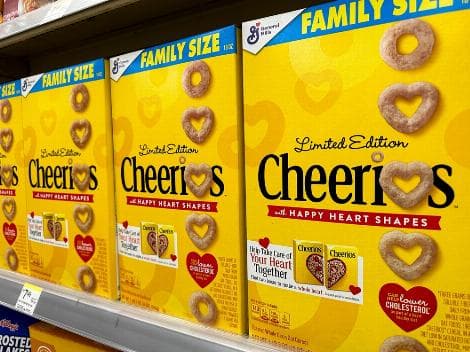
General Mills (GIS) reported better-than-expected fiscal fourth-quarter results on Wednesday, while the consumer food company said it's eyeing $3 billion in cost savings through fiscal 2030.
The maker of Cheerios cereal and Pillsbury dough posted adjusted earnings of $0.95 a share for the quarter ended May, up from $0.74 the year before, topping the FactSet-polled consensus of $0.80. Sales ticked up 1% to $4.61 billion, surpassing the Street's view for $4.59 billion. The stock gained 4.7% in the most recent premarket activity.
"We finished fiscal 2026 on a positive note, delivering fourth-quarter adjusted results that met our expectations while continuing to strengthen our foundation to position General Mills for long-term success," Chief Executive Jeff Harmening said in a statement.
General Mills is targeting about $3 billion in cost savings by fiscal 2030 as part of its efforts to tackle input cost inflation and fund growth initiatives. About $2 billion of the target is expected to be generated through the company's ongoing margin management productivity program, while the remaining amount is anticipated to be saved through its global transformation and other cost efficiency measures.
For the ongoing fiscal year, General Mills anticipates adjusted EPS to come in between $3 and $3.20, including an immaterial foreign-exchange impact, while the Street is looking for $3.13. In fiscal 2026, adjusted EPS dropped 16% to $3.55.
Organic sales are pegged to be down 1.5% to up 0.5% for fiscal 2027. In the previous fiscal year, the metric declined 2%. Category growth in the current fiscal year is expected to be in line with recent trends and below the company's long-term historical growth rate, amid a persistently challenging consumer backdrop, it said.
"Our focus in fiscal 2027 is to improve our topline growth by driving a step change in the remarkability of our brands," according to Harmening. "I'm confident we're on the path to restoring profitable growth and driving shareholder value over the long term."
For the fourth quarter, North American retail sales fell 4% to about $2.47 billion, including a 10-point headwind from divestitures. Pet sales in North America rose 4% to $702.4 million, amid gains in cat and dog foods, while pet treats were down by a low single digit.
North America foodservice sales ticked down 1% to $574.6 million, while international revenue climbed 16% to $858.4 million.