FINWIRES · TerminalLIVE
FINWIRES

Chinese Manufacturing Activity Growth Decelerates in May, S&P Global Survey Says

By
Chinese Manufacturing Activity Growth Decelerates in May, S&P Global Survey Says

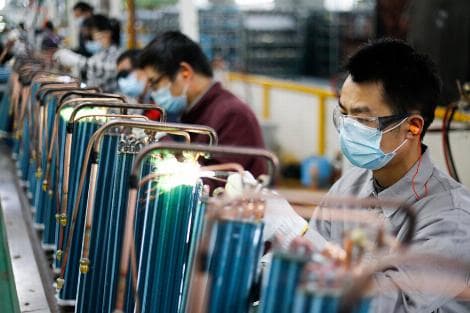
Factory activity growth in China eased in May, although new orders and output remained strong. Despite the slight slowdown, growth outpaced market expectations, according to data compiled by S&P Global on Monday.

The seasonally adjusted RatingDog China General Manufacturing PMI came in at 51.8, slower than the 52.2 mark in April, still within the growth range.

The reading for May exceeded a consensus estimate of 51.4 from Investing.com, and is also above the long-run survey trend of 50.8 since 2004, S&P Global said.

"While the rate of growth eased, it remained among the highest observed over the past five years," RatingDog founder Yao Yu said.

The figure compares with China's official purchasing managers' index, which fell to a neutral reading of 50 in may from 50.3 in April, the lowest in three months. It also came in lower than the 50.2 consensus estimate from Investing.com.

A reading above 50 means growth, while a reading below 50 indicates contraction.

Manufacturers saw an increase in new orders, signaling stronger market demand, product improvements, new customers, and promotional drives, the debt watcher said, citing panelists.

The increase in new orders was stronger than the long-run trend even if new export business slipped during the month, S&P said.

Backlogs increased for the fourth consecutive month, and manufacturing firms saw higher work-in-hand levels as staffing levels declined marginally during the month.

This compares with consumer goods firms, which saw increased staffing levels, the report said.

Inflationary pressures also softened during the month, with the seasonally adjusted input prices sub-index sliding for the first time in six months and the output prices sub-index falling for the first time in seven, S&P said.

Increased costs for raw materials and energy due to supply chain woes arising from geopolitical conflicts caused input prices to increase, S&P said.

Average supply chain lead time extended for the third straight month, but the impact remained modest, the report said.

While manufacturers sustained expansion in May and softer inflationary pressures alleviated firms' costs, continued moderation in growth and external orders "are key risks warranting attention," Yao said.

Manufacturers were also bullish about output growth over the next 12 months even as overall confidence moderated slightly in April but remained in line with the year-to-date average, S&P said.


Related Articles

South Korea's Trade Surplus Hits Record High as May Exports Surge 53% on Semiconductor Boom
US Markets

South Korea's Trade Surplus Hits Record High as May Exports Surge 53% on Semiconductor Boom

South Korea's trade surplus hit an all-time high in May, driven by a semiconductor boom that pushed exports to their fastest growth rate in four decades, according to data released Monday by the Ministry of Trade, Industry and Energy.Trade surplus reached nearly $27 billion during the month, according to figures from the ministry.Exports increased 53.2% to $87.8 billion, topping the $80 billion mark for the third straight month, the ministry said. This marks the steepest percentage increase since January 1984, beating the 48.4% growth forecast, according to Investing.com."It is truly an unprecedented pace, raising market expectations again and again and ​exceeding them again and again," Reuters quoted Meritz Securities economist Stephen Lee as saying.Semiconductor exports surged 169% to $37.2 billion during the year, led by capital investments by U.S. technology companies.Dynamic Random-Access Memory chip exports soared 370% to $18.6 billion while NAND memory chip exports jumped 207% to $1.7 billion during the month.Computer exports soared 291% to $4.18 billion due to demand for solid-state drives for artificial intelligence servers.Wireless communication device exports increased 13% to $1.46 billion."Market sentiment appears to be shifting toward the view that the semiconductor upcycle will last longer than previously expected," Bloomberg quoted BNP Paribas economist Jeeho Yoon as saying.Petroleum product exports jumped 47% to $5.25 billion on rising oil prices, but volume slid 24% amid export control measures.Automobile exports were an outlier, sliding 5.9% to $5.83 billion, led by logistics disruptions due to the war in the Middle East, as well as difficulties with car parts purchases due to domestic fires and fewer working days."The pickup in South Korea's exports in May underscores the resilience of external demand despite uncertainty from the Iran war," Bloomberg Economics' Hyosung Kwon said.An increase in semiconductor profits could also lead to rises in housing, equities, and wages, Bloomberg reported, citing Kwon.By destination, exports to China topped the list, increasing 81% to $18.9 billion, while exports to the U.S. rose 59% to nearly $16 billion. Sales to Southeast Asia jumped 58% to $15.9 billion and to the EU, up by 2% at $6.2 billion."Exports are likely to remain strong at least through the end of this year and into early next year," Bloomberg said, citing Yoon.Strong artificial intelligence-driven demand for semiconductors recently translated into surging equity valuations for South Korea's tech giants. Nvidia supplier SK Hynix (KRX:000660) last week joined the $1 trillion market capitalization club for the first time.SK Hynix's rally came just weeks after its rival, Samsung Electronics (KRX:005930) also topped $1 trillion in market capitalization.

$^KOSDAQ$^KS11$KRX:000660$KRX:005930
South Korea's Manufacturing Activity Rises to Five-Year High in May
US Markets

South Korea's Manufacturing Activity Rises to Five-Year High in May

South Korea's manufacturing sector logged its strongest activity in May since March 2021.The seasonally adjusted S&P Global South Korea Manufacturing Purchasing Managers' Index (PMI) rose to 54.8 from 53.6 in April, marking the strongest reading in five years, according to S&P Global's release on Monday.The data indicated a robust improvement in the sector's health, driven by higher demand and a surge in new orders that grew at the fastest pace since June 2021."Both new orders and production growth hit the highest for around five years, but anecdotal evidence from respondents often linked expansions to stock building efforts as the war in the Middle East continued to cause price increases and disrupt supply conditions for the manufacturing economy," said S&P Global Market Intelligence economist Usamah Bhatti.The surge in new orders drove production output higher, prompting manufacturers to expand their workforces. As a result, employment rose at the sharpest rate in over 13 years.Official data is expected to reflect this employment growth for May. In April, the unemployment rate ticked up to 2.8% from 2.7% the previous month, with the number of jobless individuals rising to 816,000 from 799,000. However, the total number of employed people also increased, reaching 28.96 million from 28.77 million.S&P Global noted that input costs remained under pressure, as the conflict in the Middle East drove up raw material prices, particularly oil.Bank of Korea data showed that producer prices increased for the eighth consecutive month in April, jumping 6.9% compared to a 4.1% rise in the previous month. South Korea remains vulnerable to global supply chain disruptions caused by the Middle East conflict.However, Min Joo Kang, ING's senior economist for South Korea and Japan, said overall activity in South Korea may start recovering in May."Both consumer and business sentiment are improving. We believe that the government's cash payouts should provide some buffer against a decline in consumption. For business sentiment, semiconductor performance remains strong," Kang said in a Friday note.Meanwhile, Jefferies predicted that the central bank may begin hiking rates in July due to an improving economic outlook and persistent inflation concerns."The headline numbers [in April] were weak, reflecting the Middle East conflict and some payback from the previous month's strong gains. The weakness was led by non-semiconductors such as autos, refining and durable goods consumption, while semiconductors continued to expand," Jefferies said in a note.The BoK held its key interest rate steady at 2.50% last week.

$^KOSDAQ$^KS11
Japan's Capital Spending Growth Grinds to a Halt in Q1
US Markets

Japan's Capital Spending Growth Grinds to a Halt in Q1

Japanese companies' capital spending was flat year over year in the first quarter, compared with the 6.5% growth in the previous quarter, according to government data released Monday.The result missed market expectations for a 4.1% increase, according to Investing.com.Capital spending fell 2% on a seasonally adjusted quarterly basis, the data showed.Meanwhile, manufacturers' spending declined 0.4% from a year earlier.Despite the weak investment figures, corporate sales rose 1.1% year over year, while ordinary profits increased 14.6%.The Iran war has rattled the global economic outlook, with oil prices surging after Tehran effectively closed the Strait of Hormuz, leaving energy-import-dependent Japan particularly vulnerable to the resulting supply shock."Capital spending came in significantly weaker than expected. While it's too early to say for certain, we may be starting to see some impact from the Middle East conflict," Yuichi Kodama, chief economist at Meiji Yasuda Research Institute, was quoted as saying by Bloomberg News."It's also possible that some companies decided at the last minute to hold back planned investment," Kodama added.The Ministry of Finance survey is closely watched as an indicator of corporate investment trends and broader economic activity in Japan.The figures will be used in revised gross domestic product data for the January-March quarter due on June 8.Preliminary data showed Japan's economy expanded at an annualized real rate of 2.1%, marking a second consecutive quarter of growth.The data leaves room for debate as the Bank of Japan's outlook weighs further interest rate increases.Recent hawkish remarks from BOJ policymakers have prompted investors to price in roughly a 79% chance of a rate increase at the June 15-16 meeting."Results were weaker than expected, reflecting a pullback from earlier strength," Kazutaka Maeda, an economist at Meiji Yasuda Research Institute, was quoted as saying by Reuters."But given steady demand for labor-saving investments and similar areas, capital expenditures are unlikely to deteriorate sharply from here," he added, noting that the outlook would depend on developments in the Middle East.

$^N225