Overall business activity across China's private sector expanded at a slightly softer pace in June, with the headline RatingDog China Composite Output Index falling to 53.6 from 54 in May.
The index, compiled by S&P Global and published Friday, deviated from the official government composite PMI released by the National Bureau of Statistics, which edged up to 50.6 from 50.5 the previous month.
The RatingDog China General Services Business Activity Index slipped slightly to 54.1 from 54.4 in May, according to the same S&P survey on Friday. In comparison, the official state non-manufacturing PMI barely rose from the neutral line, coming in at 50.2 in June from 50.1 in May.
S&P survey respondents attributed higher services activity to increased new businesses, stronger client demand, acquisition of new clients and more project developments. The survey also indicated that cost pressures eased since May.
New business volumes increased in June amid a boost in demand, including in international markets, which prompted firms to hire more manpower. Employment rose to its strongest level since July 2024
Services exports grew to its quickest rate since October 2024.
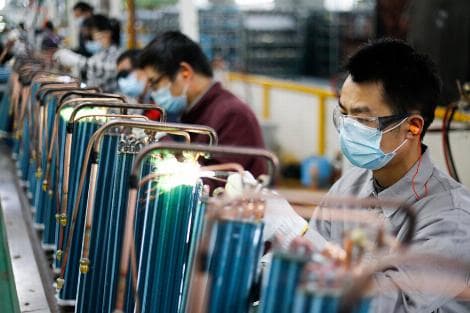
On the manufacturing side, factory activity slowed to a three-month low, with the RatingDog China General Manufacturing PMI sliding to 51.7 in June from 51.8 in May as new order growth eased, according to earlier data.
This still outperformed the official government manufacturing PMI, which returned to growth at 50.3 from a flat 50.0 in May.
"Total new business increased for the forty-second consecutive month, with growth decelerating slightly while remaining at a firm level, supported by domestic demand," RatingDog founder Yao Yu said.
"A notable positive signal came from external demand, as new export business expanded at the fastest pace so far this year, reinforcing the trend of improvement in overseas orders."
In a June 30 note, ING's chief economist for Greater China, Lynn Song, said policy support should be strengthened as domestic retail demand experiences volatility.
"It seems increasingly clear that the domestic demand engine of growth is sputtering, and further policy support would be beneficial and help avoid an increasingly unbalanced growth profile," Song said.