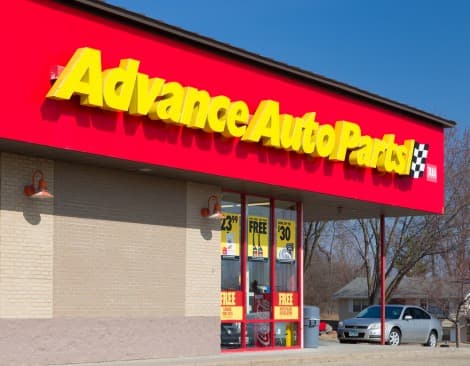
Advance Auto Parts' (AAP) fiscal second-quarter comparable sales unexpectedly declined amid weakness in the do-it-yourself channel, although the auto parts retailer lifted its full-year earnings outlook.
Comparable sales were down 0.5% in the quarter ended July 18, compared with the consensus on FactSet for growth of 1.4%.
The result reflected low-single-digit growth in the professional channel that was "more than offset" by a low-single-digit decline in DIY sales as "constrained household budgets impacted spending during the quarter," Chief Financial Officer Ryan Grimsland said during an earnings call, according to a FactSet transcript.
"The combination of a larger than anticipated deceleration in DIY spending with deferral in large ticket projects, a reduction in discretionary spending compared to last year, and weather-related drivers during (the second quarter) accounted for approximately 100 basis points to 150 basis points of comp headwind in the quarter," according to Grimsland.
The stock dropped 23% in Thursday trade, reducing its year-to-date gain to about 10%.
In an emailed client note, Truist Securities said it believes DIY trends exited the quarter at a "fairly similar" run-rate to the low end of Advance Auto Parts' annual 1% to 2% annual guide mentioned during its first-quarter earnings call. "So we suspect either commercial weakened a bit at the end of (the quarter) as well or overall results softened a bit more than we were able to see," according to the brokerage.
For fiscal 2026, the company now anticipates adjusted earnings to be in a range of $2.60 to $3.30 per share, up from its previous guidance of $2.40 to $3.10. The Street is looking for non-GAAP EPS of $2.95.
Advance Auto Parts continues to project sales to come in between $8.49 billion and $8.58 billion and comparable sales to rise by 1% to 2% for the ongoing fiscal year. The average analyst estimate is for sales of $8.58 billion and same-store sales growth of 1.7%.
During the second quarter, the auto parts retailer substantially received all of the International Emergency Economic Powers Act tariff refunds it claimed, reflecting a roughly 30-basis-point gross margin contribution for the full year, Grimsland said on the call. "However, this benefit is being fully offset by the headwind from changes in sales mix compared to our prior forecast and the incremental impact of higher shipping, freight and fuel costs in the supply chain," the CFO noted.
Earlier this year, the US Supreme Court ruled that the Trump administration lacked authority under the International Emergency Economic Powers Act to impose certain tariffs, paving the way for refunds to companies that had paid the duties.
The company's second-quarter adjusted EPS jumped to $1.03 from $0.69 a year ago, topping the market's view for $0.81. Revenue edged down to $2 billion from $2.01 billion, compared with the consensus on FactSet for a slight increase to $2.04 billion.
Trends during the first four weeks of the current three-month period are "tracking slightly ahead" of the trends in the final weeks of the previous quarter, Grimsland told analysts. "As a reminder, these first four weeks of (the third quarter) represent our most difficult comparisons to last year, and our comparisons begin to ease significantly over the next eight weeks."
Last month, O'Reilly Automotive (ORLY) lifted its full-year outlook as it reported better-than-expected second quarter comparable store sales growth. AutoZone's (AZO) latest financial results are expected to be released next month.
Price: $43.23, Change: $-12.95, Percent Change: -23.05%