FINWIRES · TerminalLIVE
FINWIRES

ABB's $5.5 Billion Takeover Bid Sends Rotork Shares Soaring

By
ABB's $5.5 Billion Takeover Bid Sends Rotork Shares Soaring

Shares of Rotork (ROR.L) skyrocketed on Thursday morning after Swiss engineering group ABB (ABBN.SW, ABB.ST) announced a $5.5 billion takeover offer for the British industrial valve actuator manufacturer.

Under the deal, which has the unanimous backing of Rotork's board, ABB is offering 5.03 pounds sterling per share in cash, plus an entitlement to an interim dividend of up to 0.03 pound per share.

Rotork's stock was up 67% in early morning trading in London, while ABB's shares were down 3% in Zürich and Stockholm.

ABB said it will finance the acquisition through existing cash and committed bank facilities, with expected net proceeds of $4.8 billion from the sale of its robotics business to SoftBank expected to mitigate the cash outflow.

Completion is expected in the first half of 2027, subject to the approval of Rotork's shareholders and regulatory clearances. Rotork, which would operate as a separate division under a strategic growth mandate within ABB's automation business area, is expected to be 3% accretive to ABB's revenue.

"ABB has followed Rotork over many years...We are convinced of the compelling strategic fit of the transaction that will expand our automation offering at the field device layer generating significant value for customers, employees, and shareholders of both companies," ABB Chief Executive Morten Wierod said.

Separately, ABB the same day reported higher first-half net income and revenue. Attributable net income for the six months ended June 30 grew to $2.56 billion from $2.25 billion a year earlier, while revenue amounted to $18.21 billion, compared with $15.68 billion earlier.
Related Articles

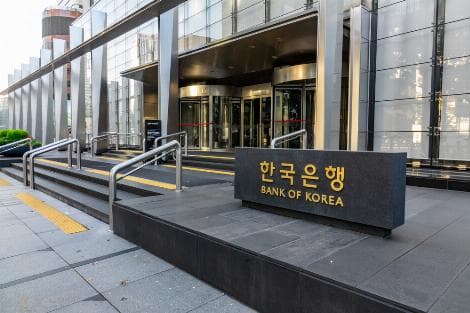
Bank of Korea Raises Benchmark Rate to 2.75% in First Tightening in 3.5 Years
US Markets

Bank of Korea Raises Benchmark Rate to 2.75% in First Tightening in 3.5 Years

The Bank of Korea unanimously raised its benchmark seven-day repurchase rate by 25 basis points to 2.75% on Thursday, marking its first interest rate hike in three and a half years.The monetary policy board, led by Governor Shin Hyun-song, pivoted back to tightening to combat persistent inflationary pressures exacerbated by rising energy costs and ongoing geopolitical volatility in the Middle East.The central bank flagged that further rate hikes remain on the table as consumer price inflation, which hit 3.2% in June, is projected to stay above its 2% target.The decision aligns with market expectations as strong AI-driven semiconductor exports continue to support the domestic economy.However, the tightening cycle comes amid warnings of a significant negative interest rate buffer. In a July 10 note, ING economist Padhraic Garvey noted that South Korea's negative interest rate buffer of -1.2% and weak won exchange rates put immense pressure on the central bank to tighten policy.Following the announcement, Capital Economics senior economist Gareth Leather noted that strong export performance and housing market risks give the Bank of Korea the capacity to raise interest rates further in the coming months.

^KOSDAQKOSPIKRX:000660KRX:005930
India Unveils $20 Billion Semiconductor, Smartphone Push
US Markets

India Unveils $20 Billion Semiconductor, Smartphone Push

India's Union Cabinet on Wednesday approved 1.9 trillion rupees ($19.7 billion) in funding for domestic semiconductor and smartphone manufacturing amid increasing competition from players like China.Of the total, 1.28 trillion rupees will fund Semicon 2.0, a second-phase expansion of India's semiconductor push, while 625 billion rupees will go toward the Mobile Phone Manufacturing Scheme, according to two separate government releases.India launched its Semicon 1.0 program in December 2021 with an outlay of 760 billion rupees. To date, the program has helped fund 12 manufacturing units with a total investment of 1.64 trillion rupees. A total of 24 semiconductor design projects from startups and MSMEs have also been approved for funding.Meanwhile, Semicon 2.0 is built on what the government calls six pillars, including chip design, manufacturing equipment and materials, new fabrication plants, assembly and testing facilities, research and development, and talent development.On design, the government said 105 startups are already developing chips."Under Semicon 2.0, the aim is to develop IPs, designs of chips and systems with this approach. The work under Semicon 2.0 will place India as a key semiconductor chip design IP count," the Union Cabinet said in the press release.On equipment and materials, the scheme will offer incentives to companies making the machines, chemicals and gases used in chip manufacturing, which the government said will also help build out India's broader precision manufacturing industry.The separate mobile phone scheme will run for five years from fiscal year 2026-2027 through 2030-2031.It will pay manufacturers incentives on eligible sales ranging from 2.25% to 5%, with an additional incentive of up to 1.5% tied to sourcing key components and sub-assemblies domestically.Over the scheme's tenure, the government expects cumulative mobile phone production of roughly 39 trillion rupees, along with a significant rise in exports and about 60,000 direct jobs.Last week, India approved a smartphone manufacturing joint venture between China's Vivo and Indian electronics manufacturer Dixon Technologies (India) (NSE:DIXON, BOM:540699). To attract more manufacturers, India also removed import duties on some electronics and smartphone parts last week.However, the company still lags behind China in terms of global smartphone production. China produced 63% of the world's smartphones in 2025, while India only accounted for 18%, TechCrunch reported, citing data from Counterpoint Research."The Prime Minister has given us clear guidance that we must create an Indian mobile brand," Indian Technology Minister Ashwini Vaishnaw was quoted by Bloomberg as saying on Wednesday.

^BSE^NSE
Update: Wall Street Extends Gains on Further Signs of Cooling Inflation
US Markets

Update: Wall Street Extends Gains on Further Signs of Cooling Inflation

(Updates with market moves at the end of the day.)US equities rose Wednesday, driving major indexes higher for a second straight day as traders digested another softer-than-expected inflation report.The Nasdaq Composite closed 0.6% higher at 26,269.2, while the S&P 500 advanced 0.4% to 7,572.4. The Dow Jones Industrial Average added 0.3% to settle at 52,658.6. Among sectors, communication services saw the biggest gain, while utilities led the laggards.Technology giant Apple (AAPL) was the best performer on the Dow, up 4%. The iPhone maker has held talks with bankers in recent months about possible acquisitions of chip companies, The Information reported, citing unnamed sources.Other tech majors also advanced, with Alphabet's (GOOGL) class A shares, Amazon.com (AMZN), and Microsoft (MSFT) following Apple on the Dow as the top performers.In economic news, US producer prices unexpectedly dropped on a monthly basis in June amid a steep decline in the cost of energy products, official data showed."We expect to see another weak reading for the July (producer prices index), even though global oil prices have moved higher in the past week," Oxford Economics said in a note.On Tuesday, government data showed that US consumer prices decreased last month for the first time in more than six years amid lower energy costs."While still nominally elevated at a dangerously high level, the relative improvement in inflation in June emboldens the more dovish argument that price pressures are already cooling and could retreat further into year-end as the lingering impact from tariffs falls off and energy prices potentially normalize amid -- still tentative -- but ongoing, US-Iran peace negotiations," Stifel said in a note Wednesday.The probability that the Fed will leave its benchmark lending rate unchanged later this month rose to nearly 90% Wednesday from 84% Tuesday, according to the CME FedWatch tool.Inflation should ease in the next few quarters as energy prices are expected to trend back closer to where they were before the US-Iran war began, New York Fed President John Williams said.Inflation is more likely to accelerate than cool given price pressures arising from an artificial intelligence boom and major supply shocks, Federal Reserve Governor Lisa Cook said. Separately, New York Fed President John Williams said that inflation should ease in the next few quarters as energy prices retreat.West Texas Intermediate crude oil was up 1.2% at $80.29 a barrel in Wednesday late-afternoon trade, while Brent rose 1.3% to $85.80.The US military conducted fresh strikes on Iran on Wednesday as tensions flare over the Strait of Hormuz, the world's most important chokepoint for crude flows, the US Central Command said.US Treasury yields were lower, with the two-year rate down 5.2 basis points at 4.14% and the 10-year rate falling 3.2 basis points to 4.55%.In other company news, PayPal (PYPL) shares jumped 17%, the top gainer on the S&P 500, after Reuters reported that Stripe and Advent International have offered to acquire PayPal in a deal that would value the payments giant at more than $53 billion.Pentair (PNR) shares slid 15%, the worst performer on the S&P 500. The water treatment company late Tuesday reported preliminary second-quarter results below market estimates and lowered its full-year outlook amid headwinds related to its pool segment.Gold edged down 0.2% to $4,060.80 per troy ounce, while silver lost 1.6% to $58.17 per ounce.

Dow JonesNasdaq CompositeS&P 500$AAPL$AMZN$GOOGL$MSFT$PNR$PYPL