FINWIRES · TerminalLIVE
FINWIRES

OPEC Lowers 2026 Global Oil Demand Growth Forecast, Lifts 2027 Outlook

By
OPEC Lowers 2026 Global Oil Demand Growth Forecast, Lifts 2027 Outlook

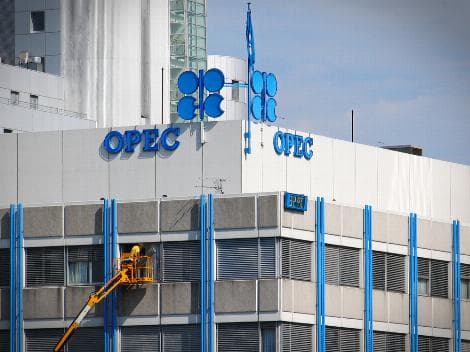
The Organization of the Petroleum Exporting Countries on Wednesday reduced its global oil demand growth outlook for 2026, but upgraded its projection for next year.

The cartel now expects oil consumption to rise by 1.17 million barrels a day this year, down from its April estimate of an increase of 1.38 million barrels.

The latest outlook reflects upward revisions in the first quarter for Organization for Economic Co-operation and Development Americas, China and other Asia, offset by downward revisions to the ongoing quarter, as well as to the third and fourth quarters for both the OECD and non-OECD. Still, OPEC described the projected growth for the entire year as "healthy."

For 2027, the cartel now expects world oil demand to rise by 1.54 million barrels a day, compared with its last month's forecast of an increase of 1.34 million barrels.

"The global economic growth in (the second quarter of 2026) is expected to slightly moderate, but to gain traction again in (the second half of the year), particularly towards the end of the year," OPEC said in its latest monthly report. "Geopolitical developments, with a focus on the Middle East situation, as well as global trade, will be key aspects to monitor in the coming weeks."

In a separate Wednesday report, the International Energy Agency forecast a sharper decline in global oil demand this year than previously expected as the Middle East conflict drives up energy prices.

Brent crude was down 1.6% at $106.06 a barrel intraday, while West Texas Intermediate fell 0.7% to $101.48.

US President Donald Trump reportedly arrived in Beijing Wednesday for a high-stakes state visit. He will meet with his Chinese counterpart, Xi Jinping, to discuss various issues. Trump recently rejected Iran's counteroffer to end the war.

OPEC maintained its forecast of an increase in liquids production from countries not participating in the Declaration of Cooperation, or DoC, by 630,000 barrels a day this year. The DoC is the name for OPEC+, which comprises OPEC and non-OPEC allies. Liquid production includes crude oil, condensate and natural gas liquids.

Late last month, the United Arab Emirates announced that it was leaving OPEC after being a member of the cartel for more than five decades.

Related Articles

Weekly Mortgage Applications Rise Despite Higher Rates, MBA Says
US Markets

Weekly Mortgage Applications Rise Despite Higher Rates, MBA Says

Mortgage applications in the US increased last week as potential homebuyers returned to the market despite rising interest rates, the Mortgage Bankers Association said Wednesday.The market composite index, which measures loan application volume, rose 1.7% for the week through Friday on a seasonally adjusted basis. Without adjustment, the index increased 2%.The seasonally adjusted purchase index rose 4% on a weekly basis, according to the report."Purchase applications were higher over the week and 7% ahead of last year's pace, with all loan types showing increases in purchase activity, as potential homebuyers shrugged off the current economic and mortgage rate uncertainties and returned to the market," Joel Kan, the MBA's deputy chief economist, said in a statement.US President Donald Trump recently rejected Iran's counter offer to end the war, dimming prospects of an imminent deal between the two sides.The average fixed rate for 30-year mortgages with conforming loan balances of $832,750 or less increased to 6.46% from 6.45% a week ago. That's the highest level in five weeks, Kan said.For loan balances higher than that amount, the rate rose to 6.48% from 6.47%. For 15-year loans, the rate was unchanged at 5.83%, according to the report.Fixed-rate mortgages with 30-year terms backed by the Federal Housing Administration increased to 6.16% from 6.12% the week before, the MBA said Wednesday. The share of FHA loans, which are often used by first-time home buyers and can involve smaller down payments, grew to 17.9% of total applications from 17.7%.The refinance index dropped 1% sequentially."Refinance applications declined slightly, led by conventional and (Veterans Affairs) refinancings, and accounted for a little more than 40% of applications last week, the lowest share since July 2025," Kan said.

Global Oil Demand Destruction Set to Intensify as Iran War Drags on, IEA Says
US Markets

Global Oil Demand Destruction Set to Intensify as Iran War Drags on, IEA Says

The International Energy Agency on Wednesday forecast a sharper decline in global oil demand this year than previously expected as the Middle East conflict drives up energy prices.The agency anticipates oil consumption to contract by 420,000 barrels a day in 2026, compared with an 80,000-barrel drop expected last month.Oil demand is projected to plunge by 2.45 million barrels per day in the second quarter."The petrochemical and aviation sectors are currently most affected, but higher prices, a weaker economic environment and demand-saving measures will increasingly impact fuel use," the IEA said.Petrochemical feedstock availability is becoming constrained, while high jet fuel prices have impacted aviation activity, according to the IEA report.Energy prices have soared since the start of the US-Israel war with Iran at the end of February. The conflict has disrupted shipments through the Strait of Hormuz. US President Donald Trump recently rejected Iran's counteroffer to end the war, dimming prospects of an imminent deal between the two sides.Brent crude fell 0.6% to $107.11 a barrel in Wednesday trading, while West Texas Intermediate rose 0.5% to $102.65.Separately, the Organization of the Petroleum Exporting Countries on Wednesday lowered its oil demand growth forecast for 2026.Global oil supply is projected to decline by 3.9 million barrels a day on average in 2026, to 102.2 million barrels, creating a supply-demand gap."More than 10 weeks after the war in the Middle East began, mounting supply losses from the Strait of Hormuz are depleting global oil inventories at a record pace," according to the report.Cumulative supply losses from Gulf producers have already exceeded 1 billion barrels since the war began, the IEA said."The current supply-demand gap is significantly smaller, however, as the market was already in surplus heading into the crisis while producers and consumers alike are responding to market signals," the IEA said.Demand may swing back to growth towards the end of the year if shipments through the Strait of Hormuz restart in the third quarter, though "supply will likely be slower to recover," the IEA said."As a result, the oil market remains in deficit until the final quarter of the year," according to the report. "With global oil inventories already drawing at a record clip, further price volatility appears likely ahead of the peak summer demand period."

US Producer Prices Rise at Fastest Pace in 4 Years on Broad Inflation
US Markets

US Producer Prices Rise at Fastest Pace in 4 Years on Broad Inflation

US producer prices in April rose at the fastest pace in four years as broad-based increases in services and goods signaled intensifying inflation pressures.The producer price index increased 1.4% on the month, the biggest gain since March 2022, after a 0.7% rise in March, Bureau of Labor Statistics data showed Wednesday. The advance was almost triple the 0.5% increase economists expected in a survey compiled by Bloomberg.Wholesale prices rose 6% from a year earlier, the largest annual increase since December 2022. Analysts expected a gain of 4.8% after an upwardly revised 4.3% rise in March.Almost 60% of April's gain came from a 1.2% jump in services prices, also the fastest since March 2022, driven by higher margins for machinery and equipment wholesalers. Goods prices rose 2%, led by a 7.8% surge in energy."On the heels of yesterday's disappointing (consumer price index) results, the April producer price report flags intense inflation pressure in the pipeline," Sal Guatieri, senior economist at BMO Capital Markets, said in a report. "The price increases were spread wide and far."Official data released Tuesday showed US annual consumer inflation accelerated in April to the fastest pace in almost three years as energy prices surged amid the near-complete closure of the Strait of Hormuz.West Texas Intermediate crude has soared more than 50% as the strait, the world's most important chokepoint for oil flows, remains largely shut since the US and Israel started a war with Iran at the end of February.The spike in producer services prices reinforced the sticky services inflation highlighted in Tuesday's CPI report, while higher core goods prices reflected lingering tariff-related pressures, Guatieri said."Look for another heated consumer inflation report in May, and not solely due to costlier gasoline, as price pressures stemming from the Iran war are bleeding into other sectors of the economy," he said.Some economists say the CPI report likely keeps the Federal Reserve in wait-and-see mode. The central bank last month held rates steady for a third straight meeting and is widely expected to do so again in June, according to the CME FedWatch tool."Shifting to a neutral policy bias might not be the only consideration of the (Federal Open Market Committee) and incoming Chair (Kevin) Warsh at future policy meetings if longer-run inflation expectations also start to warm up," Guatieri said.